 We may earn a commission — learn more
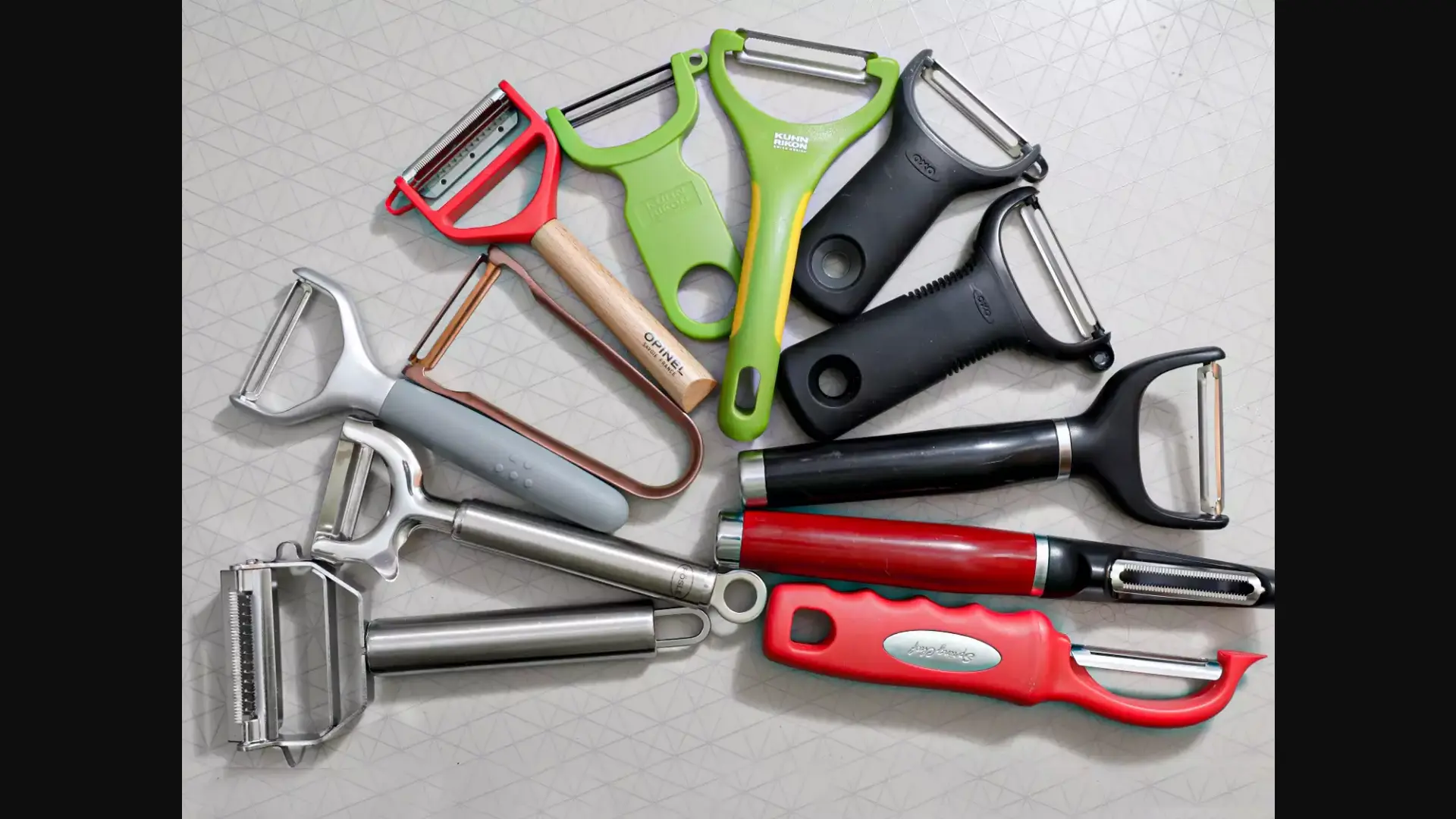
Y-Peeler vs Straight Peeler — Which Should You Buy?
Quick Verdict
Buy a Y-peeler if you peel potatoes, carrots, and apples regularly — it’s faster, more comfortable, and keeps your wrist straight. Buy a straight peeler (also called a Lancashire or swivel peeler) if you peel delicate produce, prefer the traditional feel, or want a replaceable blade system.
Most people should own a Y-peeler for daily use. The straight peeler’s advantages — control and blade sharpness — matter more for specific tasks than general use.
What a Y-Peeler Does Best
A Y-peeler has the blade perpendicular to the handle, forming a “Y” shape. You grip the handle and pull the peeler toward you or push it away in a natural up-down motion.
Pros:
- Faster for volume peeling — the motion is more natural and efficient
- Better ergonomics — wrist stays straight, reducing strain on joints
- Handle stays out of the food — no risk of your hand hitting the bowl
- Blade is protected — the U-shaped guard prevents cuts when stored
- Easier on thick-skinned produce — potatoes, carrots, butternut squash
- Eye removers (the loop on most models) work better in this form factor
Cons:
- Less control on curved surfaces — the wider head can miss contours
- Bulky for delicate work — peeling asparagus or kiwi feels imprecise
- Harder to peel in your hand — the handle gets in the way of a palm grip
- Blade angle takes getting used to if you learned on a straight peeler
Best for: Daily vegetable prep, large quantities, anyone with wrist or hand pain. See our best vegetable peeler guide for top Y-peeler picks.
What a Straight Peeler Does Better
A straight peeler (Lancashire or swivel peeler) has the blade in line with the handle, like a knife. You pull it toward you in a controlled stroke.
Pros:
- More control for delicate produce — peel tomatoes, kiwi, asparagus, and shrimp with precision
- Better in-hand peeling — the inline design lets you grip the peeler like a knife and work close to your fingers
- Thinner peels — the exposed blade can be ground sharper and cuts closer to the surface
- Better for peeling oddly-shaped items — the narrower head follows contours more naturally
- Replaceable blades — the Kuhn Rikon Original design allows $3-4 blade swaps instead of buying a new peeler
- Traditional feel — many professional chefs prefer the motion and control
Cons:
- Slower for volume work — each peel requires a deliberate pull stroke
- More wrist strain — the pull-toward motion uses different muscles than the Y-peeler’s up-down stroke
- Blade is exposed — essentially a razor blade when not in use, requires careful storage
- No eye remover — most straight peelers lack the loop for digging out potato eyes
- Less comfortable for long sessions — the thin handle concentrates pressure on your fingers
Best for: Delicate produce, precision work, anyone who prefers the traditional feel. See our best vegetable peeler guide for top straight peeler picks.
Comparison Table
| Feature | Y-Peeler | Straight Peeler |
|---|---|---|
| Speed (volume) | Excellent | Good |
| Control (delicate) | Good | Excellent |
| Ergonomics | Excellent | Fair |
| Wrist position | Straight | Bent |
| Blade storage | Protected | Exposed |
| Eye remover | Common | Rare |
| Best for | Daily prep, volume | Precision, delicate |
| Top pick | OXO Good Grips | Kuhn Rikon Original |
Bottom Line
Buy a Y-peeler (OXO Good Grips or KitchenAid) — if you peel vegetables daily and want the fastest, most comfortable option. The ergonomic advantages make it the better choice for most cooks.
Buy a straight peeler (Kuhn Rikon Swiss or Kuhn Rikon Original) — if you value razor-sharp blades, do delicate produce work, or want a replaceable blade system that lasts forever.
The truth is both designs work well. The Y-peeler is the modern, ergonomic choice. The straight peeler is the traditional, precision-oriented choice. Neither is wrong — but your peeling volume and hand comfort should drive the decision.
Decision Matrix: Which Peeler for Which Job?
| Produce / Task | Best Tool | Why |
|---|---|---|
| Potatoes (5+ lb batch) | Y-peeler | Faster stroke, less wrist fatigue, eye remover |
| Carrots (multiple) | Y-peeler | Long up-down motion matches carrot shape |
| Apples for pie (4+) | Y-peeler | Speed matters; Y-peeler halves peeling time |
| Apples (1 for eating) | Either | Both work fine for a single apple |
| Tomatoes (blanching/skinning) | Straight peeler | Thin, controlled cuts without crushing |
| Kiwi | Straight peeler | Follows the curve precisely, wastes less flesh |
| Asparagus | Straight peeler | Controlled stroke matches the spear |
| Butternut squash | Y-peeler | Wider blade handles thick skin; sturdy build |
| Shrimp (deveining) | Straight peeler | Precision control, like a small knife |
| Ginger (knobby root) | Straight peeler | Narrow head follows irregular contours |
| Large-volume meal prep | Y-peeler | Speed + ergonomics = less hand pain at 30 min |
| Kids learning to peel | Y-peeler | Natural motion, blade guard protects fingers |
FAQ
Why do most professional chefs use straight peelers?
Tradition, control, and blade sharpness. Many chefs learned on straight peelers and never switched. The straight peeler’s blade can be ground thinner and sharper than a Y-peeler’s, which means cleaner cuts through delicate produce. The inline design also gives more tactile feedback — you feel the blade edge through the handle more directly. But outside of professional kitchens (where skilled knife work is the norm), most home cooks benefit more from the Y-peeler’s ergonomics. Even many chefs own both.
Is a Y-peeler really more comfortable for people with arthritis or hand pain?
Yes — this is the Y-peeler’s strongest argument. The handle keeps your wrist in a neutral, straight position. The up-down motion uses larger arm muscles (shoulder, bicep) rather than the small muscles of the hand and wrist. Peelers with thick, soft grips (like the OXO Good Grips Y-peeler) are specifically designed for people with limited hand strength or arthritis. If you have carpal tunnel, arthritis, or any repetitive strain issues, a Y-peeler can make the difference between being able to peel vegetables and avoiding them entirely.
How often should I replace my peeler blades?
Y-peelers: replace the entire peeler every 6-12 months for heavy use, or 18-24 months for occasional use. The blade is not user-replaceable on most Y-peeler models ($8-15). Straight peelers (Kuhn Rikon): replace the blade ($3-4) every 3-4 months if you use it daily. The blade screws off and a new one slides on. Kuhn Rikon sells 3-packs of replacement blades for ~$8. A sharp peeler makes clean, thin peels; a dull peeler tears the surface and requires more pressure, increasing the risk of slipping.
Can I sharpen a peeler blade?
You can, but it’s rarely worth the effort for Y-peelers ($10-15 to replace the whole tool). Straight peeler blades are thin enough to sharpen with a fine honing rod or ceramic sharpener if you catch them before they get truly dull. But at $3-4 per replacement blade, swapping is faster and more reliable. Some high-end stainless steel peelers (Messermeister, Wüsthof) are designed to be sharpened — they use thicker blades that hold an edge longer and can withstand honing. But these cost $25-40, at which point the “is it worth sharpening” question gets more complex.
Which type is better for left-handed users?
Y-peelers are inherently ambidextrous — the blade is oriented perpendicular to the handle, so the angle is identical regardless of hand. Straight peelers are typically designed for right-handed use (blade biased to the right side). A right-handed straight peeler pulls toward the right thumb; a left-handed user has to twist their wrist or use the peeler “backwards.” Several manufacturers offer left-handed straight peelers (Rösle, Kuhn Rikon) with the blade biased left. If you’re left-handed and want a straight peeler, check that the product explicitly says “left-handed” before buying.
Does a serrated peeler exist and what is it for?
Yes — serrated peelers (like the Zyliss serrated swivel peeler) have a blade with tiny teeth. They’re designed specifically for soft-skinned produce: tomatoes, peaches, plums, and mangoes. The serrations grip the skin while a straight blade would slip. A serrated peeler is the best tool if you peel tomatoes for sauce or peaches for desserts. However, serrated blades cannot be sharpened effectively, they leave a slightly rougher surface than a sharp straight blade, and they’re not useful for normal vegetable peeling. Buy one as a dedicated “soft fruit peeler” if you do that work regularly.
Which is better for peeling in-hand (holding the produce, not on a cutting board)?
Straight peeler wins here. The inline design lets you grip the peeler like a paring knife, keeping your fingers close to the blade for control. The Y-peeler’s handle protrudes away, making it awkward to hold the produce and the peeler in one hand. For in-hand peeling (common when eating an apple on the go or peeling carrots directly into the sink), the straight peeler’s profile is more natural. For counter-based peeling with a cutting board, the Y-peeler’s up-down motion works better.
Does the material of the peeler handle matter?
Yes — it affects grip, comfort, and durability. Soft rubber or silicone grips (OXO, KitchenAid) provide the best comfort and grip, especially when hands are wet. They last 3-5 years before the rubber starts getting tacky or degrading. Metal handles (Messermeister, Wüsthof) feel more substantial and last forever but get slippery when wet and conduct cold from the refrigerator. Plastic handles are light and cheap but can crack after 1-2 years. Wood handles are aesthetically beautiful but require hand-washing and occasional oiling. For most home cooks, a soft-grip Y-peeler offers the best combination of comfort, durability, and function.
Related: Best Vegetable Peeler 2026 — Full Review
Prices and availability subject to change. We may earn a commission through affiliate links.