 We may earn a commission — learn more
Stainless Steel vs Glass Mixing Bowls — Which Should You Buy?
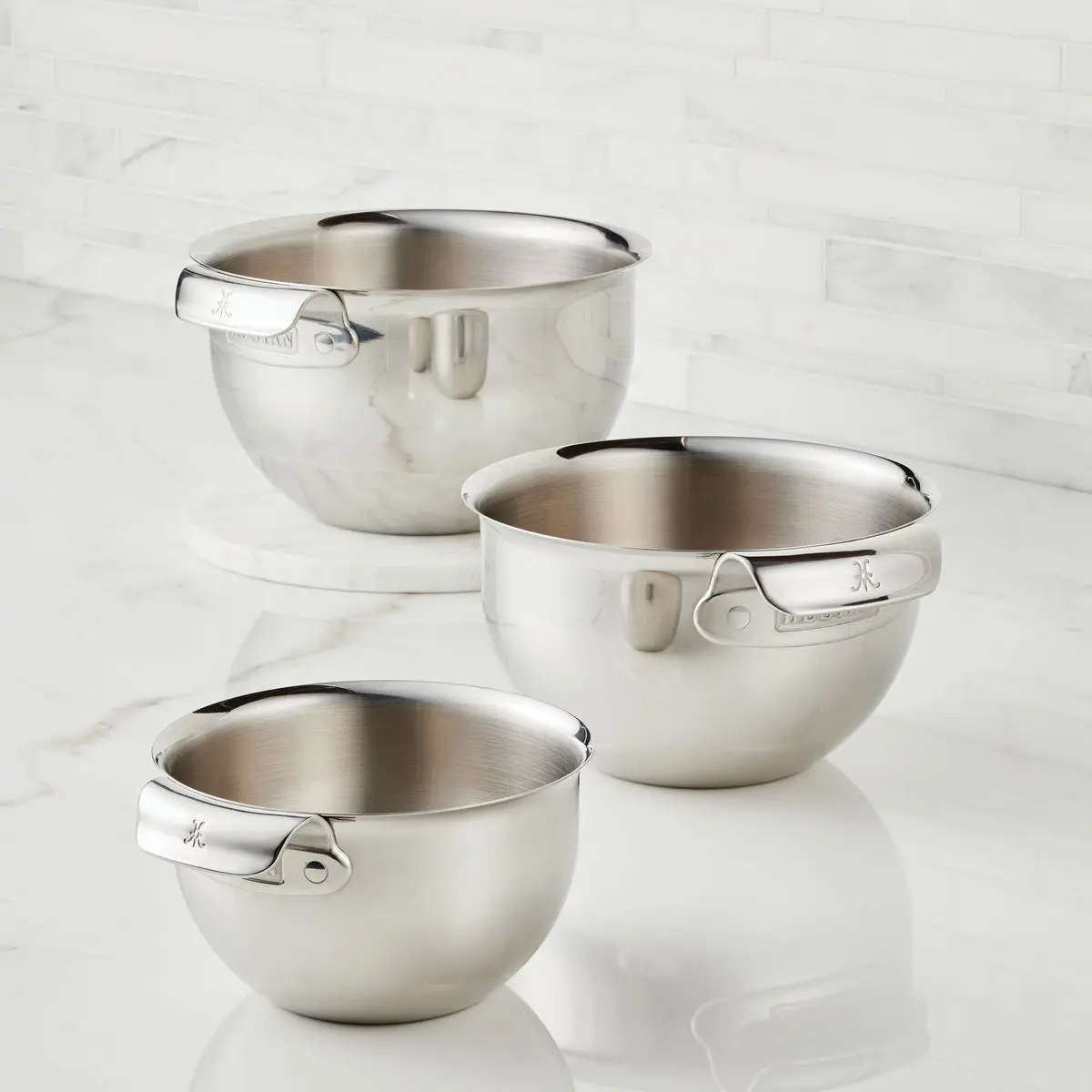
Stainless steel and glass are the two best materials for mixing bowls, and both are better than plastic. But they’re different tools for different tasks. The right choice depends on whether you value lightweight durability or microwave versatility more.
For our full rundown of specific models, read the best mixing bowls guide.
Weight and Handling
Winner: Stainless Steel
Stainless steel mixing bowls are significantly lighter. A 5qt stainless bowl weighs about 14oz — light enough to hold in one hand while whisking with the other. This matters for tasks like folding egg whites or making mayonnaise where you need to tilt and rotate the bowl continuously.
Glass bowls are heavy. A 4.5qt Pyrex bowl weighs 3.2lb — more than three times the weight of the equivalent stainless bowl. While the extra mass provides stability on the counter, it makes one-handed manipulation awkward. Fatiguing if you’re mixing dense cookie dough or kneading in the bowl.
Our take: Stainless steel wins for anyone who holds their mixing bowl while working. Glass wins if you prefer a heavy bowl that stays put without a non-slip base.
Durability
Winner: Stainless Steel
A stainless steel mixing bowl is effectively indestructible in normal use. Drop it on tile — it dents and keeps working. It won’t shatter, crack, or chip. Professional kitchens use stainless steel bowls exclusively because they survive years of abuse.
Glass bowls break. Pyrex tempered glass is tougher than soda-lime glass but it’s still glass. A drop on tile flooring usually means shards everywhere. Thermal shock is a real risk — taking a Pyrex bowl from the freezer and placing it in a hot oven can cause it to shatter (allow it to warm to room temperature first).
Our take: If you have stone or tile countertops, stainless steel is the safer choice. Glass works well on wood or laminate where breaks are less likely.
Heat Resistance and Microwave Use
Winner: Glass
This is glass’s biggest advantage. You can microwave Pyrex bowls to melt butter, chocolate, or warm ingredients right in the bowl you’ll mix in. Saves a dish. Glass can also go into a preheated oven up to 425°F — useful for melting cheese on top of a casserole or warming bread.
Stainless steel cannot go in the microwave — metal reflects microwaves and can arc, damaging your microwave. It also can’t go in a conventional oven. For tasks requiring heat, you transfer ingredients to a separate dish.
Our take: Glass is the clear winner if you frequently use your mixing bowls for microwave or oven tasks. The convenience of melting butter in your mixing bowl is surprisingly valuable.
Mixing Performance
Push: Both
Glass bowls are stable — their weight keeps them anchored on the counter during vigorous mixing. The smooth interior releases batter cleanly and lets you see what’s happening.
Stainless steel bowls excel at specific tasks. A chilled stainless bowl whips cream and egg whites faster — the cold metal stabilizes the foam. The light weight makes hand-whisking less tiring. But stainless bowls spin on the counter without a non-slip base, and you can’t see through the sides.
Our take: Glass is better for general mixing. Stainless is better for specialized tasks like whipping.
Cleaning
Push: Both
Both materials are dishwasher-safe and non-porous. Glass cleans perfectly — nothing sticks to it and it never stains. Tomato sauce, turmeric, curry — glass comes out looking like new.
Stainless steel cleans almost as well, with one exception: rolled rims on some bowls trap batter and need extra attention. The mirror finish on premium stainless shows water spots but a towel dry solves this.
Our take: Glass cleans slightly better. The difference is small.
Our Recommendation
Buy glass mixing bowls if: You microwave your mixing bowl multiple times a week (melting butter, warming ingredients), want to see your ingredients while mixing, bake occasionally, and don’t move your mixing bowl around much.
Buy stainless steel mixing bowls if: You want a lightweight set that will never break, whip cream and egg whites regularly, need compact nesting storage, and don’t need microwave capability.
Buy both if: You cook a lot and have the cabinet space. Use glass for microwave tasks, sauces, and prep. Use stainless for whipping, heavy mixing, and when you want something lighter in hand. Two basic sets cost about $50-60 combined and cover every situation.
Quick Comparison Table
| Feature | Stainless Steel | Glass |
|---|---|---|
| Weight (5qt bowl) | ~14oz | ~3.2lb |
| Drop resistance | Dents (keeps working) | Shatters |
| Microwave safe | No | Yes |
| Oven safe | No | Yes (up to 425°F) |
| Non-stick interior | No | Yes |
| Nesting storage | Yes (all sizes stack) | No (bulky) |
| See-through | No | Yes |
| Chilled for whipping | Excellent | Good |
| Dishwasher safe | Yes | Yes |
| Price (3-piece set) | $20-30 | $25-45 |
| Lifespan | Lifetime | 5-10 years (break risk) |
Decision Matrix: Which Bowl for Which Task?
| Task | Best Material | Why |
|---|---|---|
| Whipping cream or egg whites | Stainless | Cold metal stabilizes foam; light bowl for hand-whisking |
| Melting butter or chocolate | Glass | Microwave-safe; eliminates a separate dish |
| Kneading dough | Stainless | Lighter to handle; won’t break if dropped |
| Microwave prep (cheese, warming) | Glass | Only option for microwave use |
| Mixing with hand mixer | Glass | Weight keeps it stable; hand mixer won’t dent it |
| Salad tossing | Stainless | Lightweight, easy to tilt and rotate |
| Kids helping in the kitchen | Stainless | Drop-proof; glass is a safety hazard |
| Heavy cookie dough | Stainless | Lighter to maneuver; glass is fatiguing |
| Serving at the table | Glass | Looks nicer; can see contents |
| Storing leftovers with lid | Either | Both have lidded options available |
FAQ
Are stainless steel mixing bowls dishwasher safe?
Yes — most stainless steel mixing bowls are fully dishwasher safe. However, hand washing preserves the polished finish longer. Dishwasher detergents can dull the mirror finish over time (it becomes cloudy or water-spotted). The rolled rims on some bowls trap batter and may need a quick hand rinse before going in the dishwasher. Bottom line: put them in the dishwasher, but don’t be surprised if the finish loses its luster after a year.
Can I use metal mixing bowls with a hand mixer or stand mixer?
Yes — stainless steel bowls work fine with hand mixers (the beaters are harder than the bowl and won’t leave marks if you keep them submerged). For stand mixers, KitchenAid bowls are specific to each model — you cannot use a random stainless bowl in a KitchenAid. However, stainless bowls work well on the counter with a hand mixer or for manual mixing.
Do glass mixing bowls break from thermal shock?
Yes — Pyrex (borosilicate or tempered soda-lime) can break under extreme temperature changes. The common scenario: taking a glass bowl straight from the freezer and placing it into a preheated oven. To prevent thermal shock, let glass bowls warm to room temperature before heating. Don’t pour boiling liquid into a cold glass bowl. Modern Pyrex in the US is tempered soda-lime glass, which is less thermal-shock resistant than the old borosilicate Pyrex.
Which size mixing bowls do I actually need?
A 3-piece set (1.5qt, 3qt, 5qt) covers 90% of home cooking needs. The 1.5qt is for eggs, small prep, and dressings. The 3qt handles cakes, cookies, and one-bowl meals. The 5qt fits salads, bread dough, and large batches. If you bake bread or cook for a crowd, add a 7qt bowl. The smallest bowl is the most-used in most kitchens — don’t skip it.
Are expensive mixing bowls worth the money?
For stainless steel, the tier above budget ($20-30 vs $10-15) is worth it — better-gauge steel (heavier, less flimsy), rolled rims that don’t cut your hands, and a non-slip base. Beyond $40 per bowl, you’re paying for the brand name or design features (measurement markings, pour spouts) that don’t improve mixing. For glass, Pyrex at $25-45 for a 3-piece set is the standard — there’s little reason to pay more.
Why do my glass bowls slide on the counter when I whisk?
Glass bowls don’t have rubber or silicone bases (stainless steel bowls often do). Place a damp paper towel or a silicone mat underneath to stop the sliding. This is one reason stainless bowls with non-slip bases are preferred for vigorous mixing tasks like whisking egg whites or creaming butter.
Can I use metal utensils with my mixing bowls?
With stainless steel: yes — metal utensils won’t damage the bowl. With glass: yes — glass is harder than any kitchen utensil and won’t scratch. This is an advantage both materials have over non-stick coated bowls or plastic bowls, which scratch easily.
How do I remove cloudy spots from stainless steel bowls?
Cloudiness is typically hard water deposits or detergent residue. Wipe with white vinegar on a soft cloth, rinse with warm water, and dry immediately with a towel. For stubborn marks, make a paste of baking soda and water, rub gently with a soft cloth, rinse, and dry. Avoid steel wool or abrasive scrubbers — they’ll scratch the polished finish.
See our full mixing bowls review for specific model recommendations.
Prices and availability subject to change. We may earn a commission through affiliate links.