 We may earn a commission — learn more
Kitchen Shears vs Knife — When to Use Each
Before you buy, read our full kitchen shears review for model-specific recommendations.
A chef’s knife is the most important tool in your kitchen. But kitchen shears beat a knife in three specific tasks — and using the right tool for each saves time, improves results, and reduces cleanup.
Poultry Breakdown
Winner: Kitchen Shears
Breaking down a whole chicken with a chef’s knife requires: a heavy knife, a steady board, and the technique to cut through joints without shattering bone fragments. It also means washing your cutting board immediately after handling raw poultry.
Kitchen shears do it in half the time: snip through the backbone (spatchcock), cut between thigh and body, separate wings — all without a cutting board. The shears rinse clean in 5 seconds under hot water. No knife, no board, no cross-contamination risk.
When a knife wins: If you need perfectly portioned pieces for even cooking (restaurant service), a knife gives you cleaner cuts and more control. For home cooking, shears are faster and safer.
Fresh Herbs
Winner: Knife (mostly)
A chef’s knife is better for large-quantity herb prep. Rock-chopping parsley, cilantro, or mint produces a clean cut without bruising — provided your knife is sharp. The broad blade lets you gather and chop efficiently.
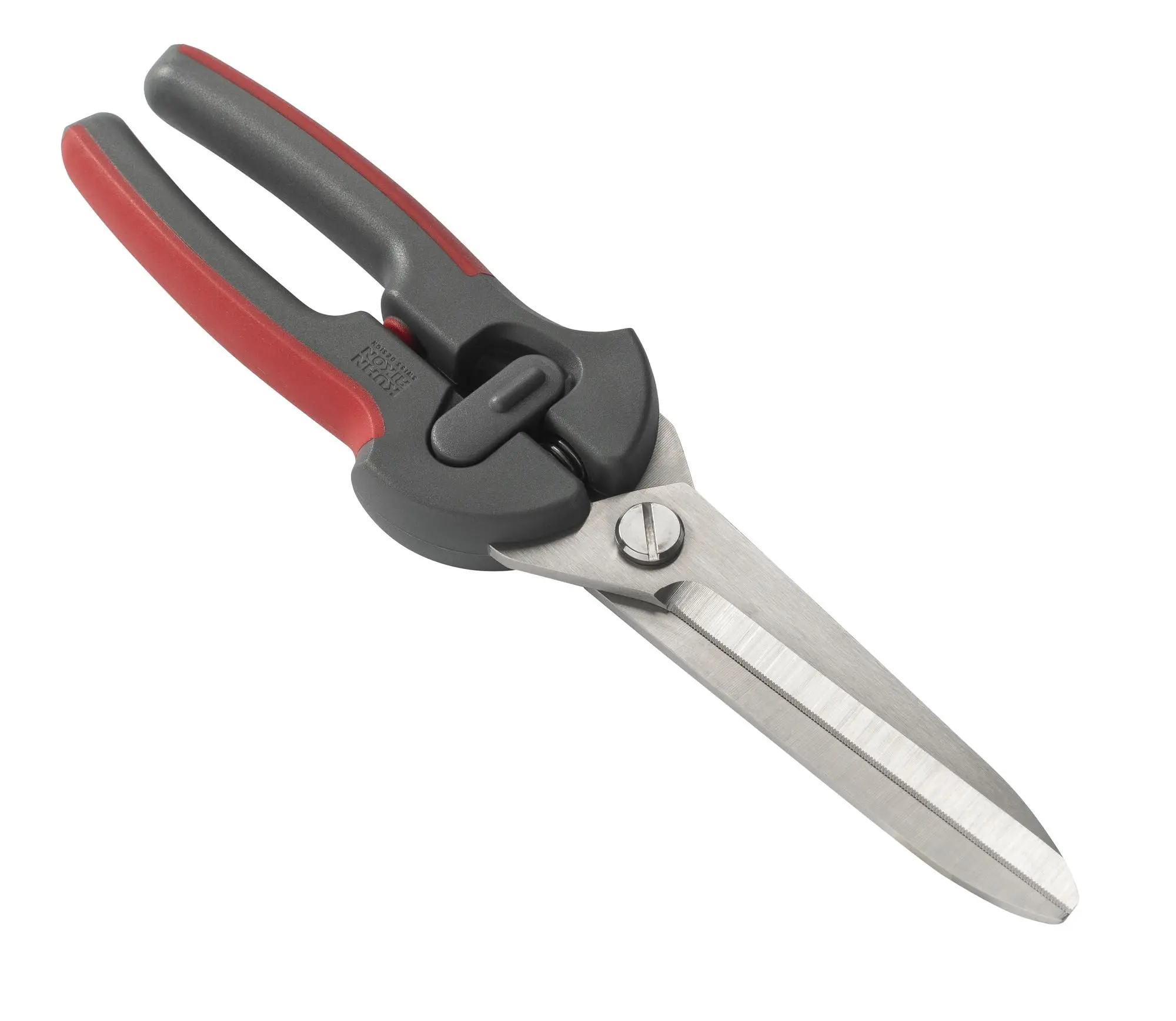
Kitchen shears win for small garnish quantities. Snipping chives over a finished dish, cutting basil into ribbons directly over pasta, or trimming rosemary sprigs — shears let you cut directly where the herb will be used, with zero board cleanup. The micro-serrated blades on models like Kuhn Rikon grip slippery herbs without crushing them.
When shears win: Garnish quantities (1-2 tablespoons), wet herbs, cutting directly into a dish. For any amount larger than a garnish, reach for the knife.
Packaging
Winner: Kitchen Shears
This is not close. Kitchen shears open everything a knife cannot:
- Clamshell plastic — a knife tip can slip and stab you; shears clip through the edges safely
- Vacuum-sealed bags — a knife risks cutting the contents (cheese, meat); shears open precisely at the seal
- Twist ties and zip ties — a knife is awkward and dangerous; shears snip cleanly
- Food pouches (sous-vide, frozen vegetables) — cut the corner with shears for a controlled pour spout
One caveat: Do not use your kitchen shears on non-food packaging (tape, cardboard, zip ties from electronics). The adhesive dulls blades fast. Reserve a cheap pair for non-food cutting.
Bottom Line
Use kitchen shears for: Poultry breakdown, small herb garnishes, opening any food packaging. Faster than a knife, less cleanup, safer for awkward cuts.
Use a knife for: Large-quantity herb prep, dicing vegetables, portioning meat, and any task requiring precision cuts on a cutting board.
What to buy: A good pair of take-apart shears (like Kuhn Rikon at $20) alongside your chef’s knife covers every cutting task in your kitchen. They are complementary tools, not replacements for each other.
Decision Matrix
| Task | Shears | Knife | Why |
|---|---|---|---|
| Breaking down a whole chicken | ✅ Best tool | ❌ Slow, requires board | Shears snip joints in seconds; no board needed |
| Chopping herbs (large bunch) | ❌ Crushes more than cuts | ✅ Best tool | Rock chop with knife is faster and cleaner |
| Sprinkling chives as garnish | ✅ Best tool | ❌ Awkward for tiny amounts | Snip directly over the dish with shears |
| Opening clamshell packaging | ✅ Best tool | ❌ Dangerous (knife can slip) | Shears clip through plastic safely |
| Dicing an onion | ❌ Unusable | ✅ Best tool | Knife is purpose-built for volume dicing |
| Cutting pizza | ✅ Great for quick slices | ✅ Also works | Both work; shears avoid dragging toppings |
| Trimming silverskin from meat | ❌ Too coarse | ✅ Best tool | Knife gives precise control over fat removal |
| Opening vacuum-sealed bags | ✅ Best tool | ❌ Risks cutting contents | Shears open at the seal precisely |
| Spatchcocking a turkey | ✅ Best tool | ❌ Can shatter bone | Shears cut through ribs and backbone cleanly |
| Snipping rosemary sprigs | ✅ Best tool | ❌ Leaves bruise easily | Shears cut clean without crushing needles |
FAQ
Can kitchen shears replace a chef’s knife? No. Shears excel at 3 specific tasks (poultry, packaging, small garnishes) but cannot replace a chef’s knife for the 30+ other cutting tasks in a typical kitchen — dicing, slicing, chopping, mincing, julienning. Shears complement a knife; they do not replace it.
Should I buy take-apart or fixed kitchen shears? Take-apart shears (where the two blades separate at the pivot) are essential for poultry work. The joint is the hardest part to clean on fixed shears, and raw chicken fat trapped in the pivot is a contamination risk. Take-apart shears also make sharpening practical — each blade can be honed individually. Kuhn Rikon ($20) and kitchen pro shears ($15-20) are the best take-apart options.
How do I sharpen kitchen shears? Most kitchen shears cannot be sharpened with a standard knife sharpener because the blades have a micro-serrated edge. Send them to a professional sharpener or replace them ($15-20) when dull. Some high-end shears (like Shun or Wusthof) have standard straight edges that can be honed with a fine diamond rod. For the vast majority of home cooks, replacement is cheaper than professional sharpening.
Can I wash kitchen shears in the dishwasher? For take-apart shears: yes — separate the blades and place them in the utensil basket. The high heat will not damage high-carbon stainless steel blades. For fixed shears: no — the pivot joint will trap food particles and may rust. Always hand-wash and dry fixed shears immediately. Even take-apart shears will last longer with hand washing.
Are kitchen shears safe for cutting bones? Yes, for poultry bones (chicken, turkey, duck, quail). No, for beef, pork, or lamb bones. Poultry bones are hollow and brittle — shears can cut through them cleanly. Mammal bones are dense and will damage the blades. Use a cleaver or hacksaw for beef or pork bones.
Do expensive kitchen shears make a difference? For occasional use (once a week): a $10-15 pair is fine. For daily use: spend $20-30 on take-apart shears with micro-serrated blades. The difference is blade retention (cheap shears dull in 3-4 months, good shears last 1-2 years), ergonomics (better handle comfort for repetitive cutting), and detachability for cleaning. Beyond $30, you pay for aesthetics and brand name — performance plateaus around $25.
Prices and availability subject to change. We may earn a commission through affiliate links.