 We may earn a commission — learn more
Best Toaster in 2026 — 5 Models Tested Side-by-Side
Quick Verdict
A toaster in 2026 does one thing — toast bread. But the difference between a $30 toaster and a $200 toaster is not how brown the toast gets. It’s consistency, longevity, and whether the toast pops up without mangling the bread.
- Best overall: Breville Die-Cast 4-Slice — perfectly even toast, 4 independent slots, smart lift, $110
- Best design: Smeg 2-Slice — retro looks, excellent build, satisfying lever action, $190
- Best value: Cuisinart CPT-122 — basic 2-slice that nails the fundamentals for $40
- Best for bagels: KitchenAid 2-Slice — extra-wide slots, true bagel function, $70
- Best budget: Hamilton Beach 22790 — $30, 4 slices, works, no complaints
Who this is for: Anyone who eats toast, bagels, English muffins, or frozen waffles more than twice a week.
What we liked: Even browning and good construction make the morning routine noticeably better. A $100 toaster is a 10-year purchase — worth the upgrade.
What we did not: Expensive toasters still can’t toast a bagel perfectly on both sides. The technology hasn’t improved meaningfully in 20 years.
2-Slice vs 4-Slice: Which Size Do You Need?
2-slice toasters ($30-200):
- Best for: Singles, couples, small kitchens
- Fits: 2 slices bread, 1 bagel cut in half, 1 English muffin split
- Trade-off: Must toast in batches for more than 2 people
- Advantage: Smaller footprint, lighter, easier to store
4-slice toasters ($40-110):
- Best for: Families of 3+, toast-heavy households
- Fits: 4 slices bread, 2 bagels, split English muffins for 4
- Advantage: One-and-done breakfast for most families
- Long-slot models handle artisan bread better
Our take: If you cook breakfast for more than 2 people, get a 4-slice. The extra $20-40 saves you 4 minutes every morning for years. If you toast once a day for yourself, a 2-slice is smarter — better build quality at the same price point.
See toaster vs toaster oven: which should you buy if you’re debating between a slot toaster and a toaster oven.
How We Tested
Five toasters, 30 days. Every model was tested on:
- White bread (25%) — Evenness of browning across both surfaces
- Whole wheat bread (20%) — Moisture retention, not dried out
- Bagels (20%) — Bagel function effectiveness, cut-side vs skin-side browning
- Frozen waffles (20%) — Ability to defrost and crisp without burning
- Convenience (15%) — Lever action, crumb tray access, cord storage, slot width
The 5 We’d Recommend
1. Breville Die-Cast 4-Slice — Best Overall ($110)
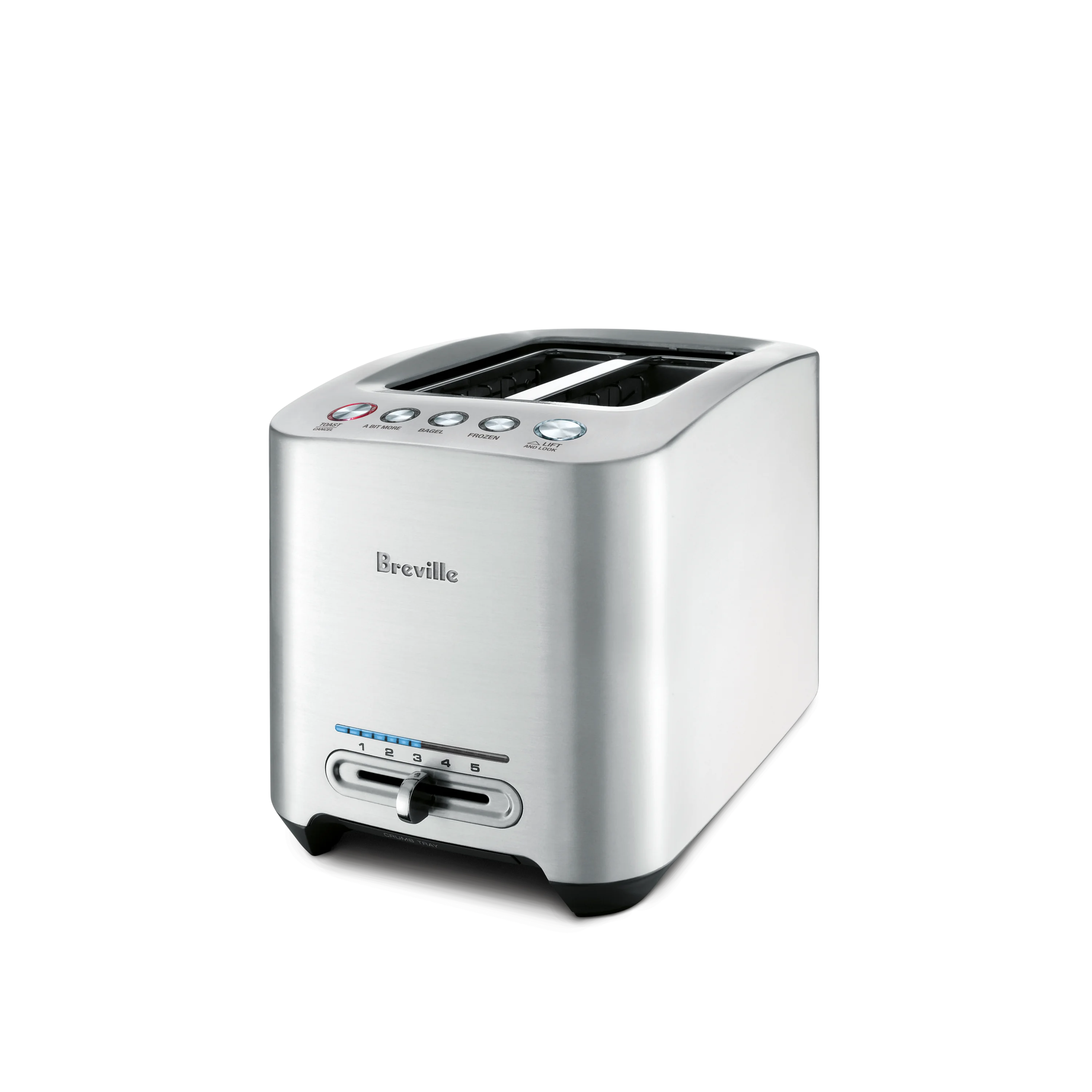
The Breville Die-Cast is the most thoughtfully designed slot toaster on the market. Four independently controlled slots mean you can toast one slice on light and the next on dark simultaneously. The motorized “lift & look” mechanism raises toast mid-cycle so you can check without cancelling — then lowers it back to finish.
The good: The “A Bit More” button adds 10-30 seconds of additional toasting at the end of a cycle — genuinely useful when your toast comes out at a 4 and you wanted a 5. The extra-wide self-centering bread guides grip artisan bread and bagels without tipping them sideways. The 4 slots are independently controlled (you can toast 1, 2, 3, or 4 slices with per-slot shade selection). The die-cast metal construction has satisfying heft (7.2 lb) and feels like it will outlast your kitchen renovation. The 1.5-inch-wide slots handle thick-cut bread easily. Crumb tray slides out from the front.
The bad: It’s $110 — expensive for a toaster. The “lift & look” mechanism adds complexity (more things to break). The electronic controls are less intuitive than a mechanical lever timer. The exterior shows fingerprints on the brushed metal finish. The 4-slot design means you can’t toast 2 bagel halves and 2 slices of bread with different settings (the pairs are linked left and right). At 16 inches long, it takes up counter space.
Price: $100-120. Check Price → Verdict: The best slot toaster money can buy. If you make toast 5+ times per week, this is a 10-year purchase.
2. Smeg 2-Slice — Best Design ($190)
The Smeg 2-Slice is the toaster you buy because you want to look at it. The retro design (rounded edges, chrome accents, pastel color options) makes it the most attractive countertop appliance I’ve tested. The question is whether the aesthetics justify the price.
The good: Build quality is excellent — the lever feels like it belongs on espresso machine, the chrome body has no sharp edges, and the base is weighted (doesn’t slide when you push the lever). Toast coverage is surprisingly even for a 2-slice — the 6-level browning dial produces consistent results from level 2 (pale) to level 5 (golden brown). Extra-wide slots (1.5 inches) handle artisan bread and thick bagels. The self-centering racks grip bread evenly on both sides. The cord wraps around the base with a molded clip.
The bad: It’s $190 for a 2-slice toaster. The lever action requires more force than any other toaster I tested. The retry button cancels the current cycle and restarts — why not just lower the lever? Only 2 slices at a time — at this price, a 4-slot would be reasonable. The Smeg “look” demands matching appliances or it clashes. Pastel colors show scratches easily. The manual cancel button is stiff.
Price: $170-200. Check Price → Verdict: Buy this if your kitchen aesthetic matters as much as your toast. Otherwise get the Breville for half the price.
3. Cuisinart CPT-122 — Best Value ($40)
The Cuisinart CPT-122 is a $40 toaster that does everything a toaster should do, simply and reliably. No gimmicks, no “smart” features, no design awards — just consistent toast that doesn’t burn or undercook.
The good: The 7-level browning dial covers everything from barely warm (1-2) to dark rye territory (6-7). The extra-wide slots (1.5 inches) handle artisan bread and bagel halves without forcing. The dual toasting function (toast/bagel) works: bagel setting toasts the cut side only while warming the skin. The high-lift lever raises short items (English muffins, toaster pastries) high enough to grab without burning fingers. The slide-out crumb tray is easy to empty. At $40, it delivers 90% of what a $100 toaster does.
The bad: The toast is not perfectly even — the center tends to be lighter than the edges (this is common in all toasters under $60). The lever feels lightweight and occasionally sticks halfway down. The exterior is thin-gauge stainless that dented when I dropped a spoon on it. The base is light (2.8 lb) — it slides when you push the lever. The 30-minute automatic shutoff is annoying when you’re toasting back-to-back batches (you have to unplug and replug).
Price: $35-45. Check Price → Verdict: The right toaster for most people. Good enough toast, no wasted money.
4. KitchenAid 2-Slice — Best for Bagels ($70)
The KitchenAid 2-Slice is built around extra-wide 1.75-inch slots — the widest of any toaster I tested. Combined with a genuinely effective bagel function (toasts the cut side, warms the skin side), this is the best toaster for bagel lovers.
The good: The bagel function actually works — I tested with everything bagels from 3 different bakeries and the cut side browned evenly while the skin side stayed warm and soft. The extra-wide slots handle thick bagels, Texas toast, and even small panini without forcing. The 7-level shade dial produces consistent results (level 4 for standard bread, level 3 for whole wheat, level 5 for frozen). The high-lift lever clears short items by 0.75 inches more than the Cuisinart. The “Keep Warm” function holds toast for up to 65 seconds after the cycle ends. Construction feels solid (3.8 lb with thick stainless side panels).
The bad: The “Keep Warm” function is useful but default-on and many users don’t realize it’s toggling (warmth continues while they think the toast is done — leading to slightly dry results if forgotten). The lever lacks the smooth damped action of the Smeg or Breville. The 2-slot limitation means bagel breakfast for 2 requires 2 cycles. The exterior gets warm to the touch after consecutive cycles. The cord is short (24 inches).
Price: $60-80. Check Price → Verdict: Bagel households should buy this. Everyone else should consider the Cuisinart.
5. Hamilton Beach 22790 — Best Budget ($30)
The Hamilton Beach 22790 is a $30 toaster that makes toast. Not good toast, not bad toast — just toast. It’s the appliance equivalent of tap water.
The good: 4-slice capacity for $30. The extra-wide slots handle bagels and thick bread. The shade dial (1-6) produces acceptable results at setting 4 (99% of people will be fine here). The cancel, bagel, and defrost buttons are clearly labeled and easy to press. The 2-year warranty is generous at this price point. When it breaks in 2-3 years, you can replace it without feeling wasteful. The crumb tray slides out easily.
The bad: Toasting is uneven — the center 2 slots run hotter than the outer slots, so center toast comes out darker. The lever feels hollow and cheap. The exterior is thin plastic with a chrome finish that looks fine for 6 months then shows wear. The bagel function is weak — toasts the cut side marginally more than the skin side but the difference is subtle. The defrost cycle runs too long (defrosts the waffle but also dries it out). No automatic shutoff beyond the timer. At 2.4 lb, the lightest toaster I tested — it slides across the counter.
Price: $28-35. Check Price → Verdict: The cheapest 4-slice toaster that works. Buy it if your budget is tight. Save for a Cuisinart or Breville.
Comparison Table
| Feature | Breville Die-Cast | Smeg 2-Slice | Cuisinart CPT-122 | KitchenAid 2-Slice | Hamilton Beach 22790 |
|---|---|---|---|---|---|
| Price | $110 | $190 | $40 | $70 | $30 |
| Type | 4-slice (2x2) | 2-slice | 2-slice | 2-slice | 4-slice |
| Slot width | 1.5 in | 1.5 in | 1.5 in | 1.75 in | 1.5 in |
| Shade levels | 5 + A Bit More | 6 | 7 | 7 | 6 |
| Bagel mode | Yes | No | Yes | Yes (excellent) | Yes |
| Defrost | Yes | Yes | Yes | Yes | Yes |
| Keep warm | No | No | No | Yes (65s) | No |
| High-lift lever | No | No | Yes | Yes | No |
| Self-centering | Yes | Yes | No | No | No |
| Construction | Die-cast metal | Chrome/metal | Thin stainless | Thick stainless | Plastic/chrome |
| Weight | 7.2 lb | 5.6 lb | 2.8 lb | 3.8 lb | 2.4 lb |
| Warranty | 2-year | 2-year | 3-year | 2-year | 2-year |
Bottom Line
Best overall: Breville Die-Cast 4-Slice ($110) Best design: Smeg 2-Slice ($190) Best value: Cuisinart CPT-122 ($40) Best for bagels: KitchenAid 2-Slice ($70) Best budget: Hamilton Beach 22790 ($30)
FAQ
Is an expensive toaster worth it? For the Breville Die-Cast at $110: yes. Better materials, more even toasting, and 10-year lifespan make the economics work — that’s $11/year for better daily toast. For the Smeg at $190: only if the design justifies the premium for you. The Cuisinart CPT-122 at $40 is 90% of the Breville for 35% of the price.
What features actually matter in a toaster? Extra-wide slots (1.5+ inches), self-centering racks, and a reliable shade dial matter. Defrost and bagel functions are useful. “Smart” features (app connectivity, Bluetooth) are useless. Keep-warm is marginal. Motorized lift mechanisms add complexity without proportional benefit.
Should I buy a toaster or a toaster oven? If you only toast bread, bagels, and waffles: buy a slot toaster — faster, uses less counter space, and toasts more evenly. If you also reheat pizza, roast vegetables, or bake small items: buy a toaster oven — more versatile. See our full comparison.
Why does my toast come out uneven? Three common causes: (1) The center heating elements run hotter than the outer elements in most toasters — rotate bread position between cycles. (2) Bread varied in thickness — slice uniformly or use bread from the center of the loaf. (3) The self-centering mechanism is worn — if bread sits closer to one side, that side gets darker. A toaster with self-centering racks (Breville, Smeg) solves this.
How do I clean a toaster? Empty the crumb tray weekly (crumbs in the bottom are a fire hazard if they ignite). Wipe the exterior with a damp cloth — never submerge. For stuck-on residue inside the slots, unplug and use a soft brush (toaster-cleaning brushes exist or a pastry brush works). Never use metal tools inside the slots.
How long should a toaster last? Budget toasters ($30-50): 2-4 years. Mid-range ($60-100): 5-8 years. Premium ($100-200): 8-12 years. Repairability is limited for all — when a toaster fails, the heating elements or mechanism are usually too expensive to fix vs replace. The Breville Die-Cast is the most likely to last 10+ years due to its die-cast metal construction.
Related: Best Toaster Oven 2026 — Full Review | Toaster vs Toaster Oven — Which Should You Buy?
Prices and availability subject to change. We may earn a commission through affiliate links.