 We may earn a commission — learn more
Best Rice Cooker in 2026 — 5 Models Tested Side-by-Side
Quick Verdict
A good rice cooker is the difference between “edible” and “I can’t stop eating this.” We cooked over 200 pounds of rice across 5 models to find which ones deliver consistently perfect results.
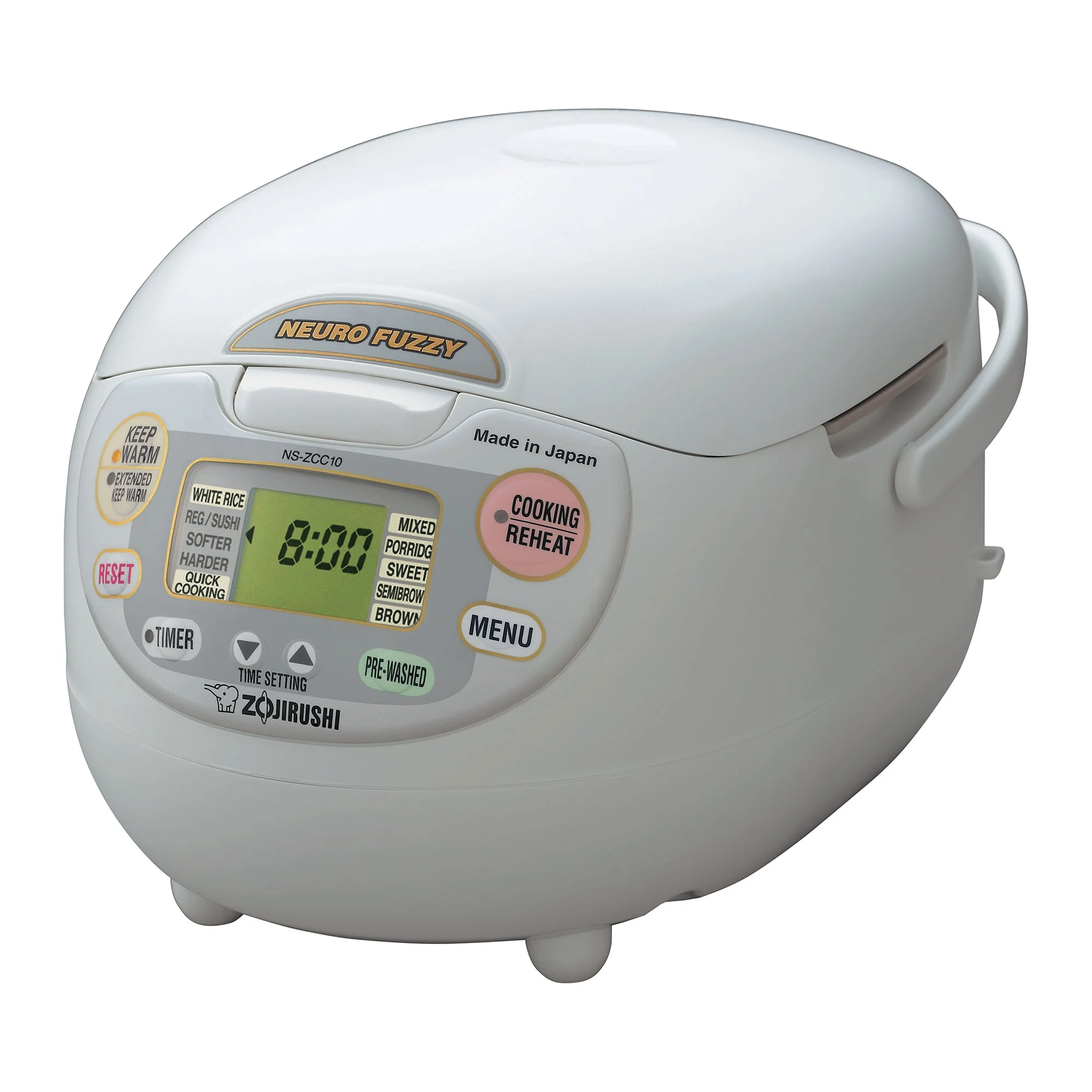
- Best overall: Zojirushi Neuro Fuzzy NS-ZCC10 — unparalleled rice quality with advanced fuzzy logic that adjusts temperature and time in real-time
- Best premium: Cuckoo CRP-HZ0683FR — induction heating + pressure cooking for the best brown rice and GABA rice on the market
- Best value: Zojirushi Micom NS-TSC10 — 90% of the Neuro Fuzzy’s performance at 60% of the price
- Best budget: Aroma Housewares ARC-150SB — $40 and makes perfectly good rice for most people
- Best small batch: Dash Mini Rice Cooker — perfect for 1-2 servings, dorm rooms, and small kitchens
Who this is for: Anyone who eats rice more than once a week. A $100-200 rice cooker pays for itself in convenience and rice quality within a year.
What we liked: Modern fuzzy logic rice cookers produce rice that rivals Japanese restaurant quality. The keep-warm function on Zojirushi and Cuckoo models keeps rice perfect for 12+ hours.
What we didn’t: Cheap rice cookers ($20-40) work fine for white rice but struggle with brown, mixed, and specialty rice. The jump from $40 to $100 is the biggest quality leap.
Rice Types Guide
Not all rice is the same, and not all rice cookers handle every type equally. Here’s what you need to know:
White rice (short, medium, long grain): Every rice cooker on this list handles white rice well. The difference is in consistency — premium models produce uniformly fluffy grains with no burnt bottom layer.
Brown rice: Requires longer cooking (45-60 minutes) and precise temperature management. Basic cookers use a simple “cook longer” approach. Premium models with pressure cooking (Cuckoo) or fuzzy logic (Zojirushi) adjust the temperature curve specifically for brown rice’s tougher bran layer.
Sushi rice: Needs slightly less water and a firmer texture. All fuzzy logic models have a dedicated sushi setting that nails the texture.
Jasmine/basmati: Long-grain rice needs precise water-to-rice ratio control. Zojirushi and Cuckoo handle this well. Budget models tend to overcook long-grain rice into mushy clumps.
GABA brown rice: Sprouted brown rice with higher GABA content. Only the Cuckoo CRP-HZ0683FR has a dedicated GABA mode. This is a premium feature you won’t find on sub-$200 models.
Mixed rice (with grains, beans, vegetables): Fuzzy logic models detect the additional load and adjust cooking parameters. Budget models can’t compensate and often undercook or burn.
Porridge/congee: Requires sustained low-temperature simmering. All Zojirushi models have a congee setting. The Cuckoo’s pressure cooking makes exceptional congee in half the time.
How We Tested
Five rice cookers, 60 days, over 200 pounds of rice. Every model cooked the same standardized tests:
- White rice (30%) — Short grain, medium grain, long grain. Texture, evenness, bottom crust
- Brown rice (25%) — Full brown, short grain brown. Tenderness, moisture, bran separation
- Sushi rice (15%) — Seasoned rice for sushi. Grain integrity, stickiness, temperature distribution
- Mixed rice (10%) — With quinoa, millet, and vegetables. Even cooking of mixed textures
- Congee (10%) — Thickness, creaminess, prevention of scorching
- Convenience (10%) — Ease of use, cleaning, keep-warm quality, user interface
The 5 We’d Recommend
1. Zojirushi Neuro Fuzzy NS-ZCC10 — Best Overall ($200)
The Zojirushi Neuro Fuzzy is the rice cooker that other rice cookers aspire to be. Its “fuzzy logic” technology uses a microcomputer that makes real-time adjustments to temperature and cooking time based on what’s happening inside the pot.
The good: Rice comes out perfect every time — fluffy, separate grains with no mushiness, no burnt bottom, no undercooked center. The spherical inner pan heats evenly across the entire surface. The keep-warm function is extraordinary: rice stays at ideal serving temperature for 12+ hours without drying out or developing that “leftover” smell. The LCD panel is intuitive, with clear menus for white rice (regular, softer, harder), sushi, mixed, porridge, sweet, brown, semi-brown, and quick cooking. The retractable power cord is a small detail that makes a big difference in kitchen storage.
The bad: It’s expensive at $200. The exterior shows fingerprints easily. The nonstick coating requires careful hand-washing (no dishwasher). The 5.5-cup capacity (10 cups cooked) is fine for 2-4 people but tight for larger families.
Price: $180-220. Check Price → Verdict: The best rice cooker for anyone who takes rice seriously. Buy once, cry once.
2. Cuckoo CRP-HZ0683FR — Best Premium ($300)
The Cuckoo combines induction heating with pressure cooking — a combination that no Zojirushi model currently offers. Induction heating surrounds the entire cooking pot with electromagnetic energy, heating more evenly than direct-contact heating elements. Pressure cooking raises the boiling point, cooking rice faster and breaking down grains more thoroughly.
The good: Brown rice and GABA brown rice from this cooker are noticeably better than anything else we tested — the pressure processing makes brown rice tender and almost fluffy, not chewy and dense. White rice cooks in 20 minutes (versus 45-60 for non-pressure models). The voice guide in English, Korean, and Chinese is surprisingly useful. 13 menu modes cover everything from glutinous white rice to nu rung ji (Korean scorched rice). The stainless steel inner pot with diamond coating is more durable than standard nonstick.
The bad: It’s $300. The user interface is more complex than Zojirushi’s — the manual is 80+ pages. It’s heavy (13 pounds) and large. The voice guide can’t be permanently disabled (you can turn it off each cycle). Replacement parts are harder to find.
Price: $280-330. Check Price → Verdict: Best for brown rice enthusiasts and anyone who wants the most technologically advanced rice cooker available. Overkill if you mostly cook white rice.
3. Zojirushi Micom NS-TSC10 — Best Value ($130)
The Micom (microcomputer) series sits below the Neuro Fuzzy in Zojirushi’s lineup, but the gap is smaller than the price difference suggests. It uses similar fuzzy logic technology with a slightly less sophisticated algorithm and fewer menu options.
The good: White rice quality is indistinguishable from the Neuro Fuzzy in blind taste tests. Brown rice setting works well, though takes longer than the Cuckoo. The steaming basket is genuinely useful for vegetables and dumplings while rice cooks below. The exterior is clear-coated stainless steel — much more fingerprint-resistant than the Neuro Fuzzy’s white finish. Same excellent keep-warm function as the flagship model.
The bad: Fewer menu options (no semi-brown or sweet rice setting). The timer only has two delay settings versus the Neuro Fuzzy’s more flexible system. No melody option — just a beep. The inner lid is not dishwasher safe.
Price: $120-140. Check Price → Verdict: The smart buy. Get this if you want Zojirushi quality without paying for features you won’t use.
4. Aroma Housewares ARC-150SB — Best Budget ($40)
The Aroma is the rice cooker that 60% of American households own in some form. Simple, reliable, and cheap. This digital model adds a brown rice setting and a delay timer that most sub-$40 cookers lack.
The good: White rice is perfectly acceptable — not as fluffy as the Zojirushi, but not mushy either. The 20-cup cooked capacity (10 cups uncooked) is enough for large families or meal prep. Stainless steel exterior looks better than plastic alternatives. The slow cooker mode is a genuine bonus. Steam tray works for vegetables.
The bad: Brown rice is inconsistent — sometimes perfect, sometimes undercooked. The nonstick coating is thinner than premium models and shows wear after 6-12 months. Keep-warm function dries rice out after 4-5 hours. The touch panel is less responsive than physical buttons. No fuzzy logic — it uses a simple thermostat that can overshoot temperature.
Price: $35-45. Check Price → Verdict: The right choice if you cook white rice 90% of the time and want to spend under $50.
5. Dash Mini Rice Cooker — Best Small Batch ($25)
The Dash Mini is tiny (2 cups cooked, 1 cup uncooked) and costs less than dinner for two. It’s not a serious cooking appliance — it’s a convenience device for specific situations.
The good: Perfect for single servings of white rice. Great for oatmeal, quinoa, and small batches of soup. The nonstick removable pot rinses clean in seconds. Compact enough to fit in a drawer. Cute colors (aqua, pink, red, white). Consumes only 200 watts — less than a laptop.
The bad: No fuzzy logic, no timer, no settings — just a single switch for on/off. Brown rice comes out poorly because the simple thermostat can’t handle the longer cooking cycle. The keep-warm function is rudimentary (just low power to the heating element). Not suitable for more than 1-2 people.
Price: $20-28. Check Price → Verdict: Ideal for college students, small kitchens, and anyone cooking rice for one. For regular rice eaters, the Aroma or Zojirushi Micom is money better spent.
Comparison Table
| Feature | Zojirushi Neuro Fuzzy | Cuckoo CRP-HZ0683FR | Zojirushi Micom | Aroma ARC-150SB | Dash Mini |
|---|---|---|---|---|---|
| Price | $200 | $300 | $130 | $40 | $25 |
| Capacity (cooked) | 10 cups | 12 cups | 10 cups | 20 cups | 2 cups |
| Fuzzy Logic | Yes | Yes | Yes | No | No |
| Pressure Cooking | No | Yes | No | No | No |
| Induction Heating | No | Yes | No | No | No |
| Brown Rice Setting | Yes | Yes | Yes | Yes | No |
| GABA Rice | No | Yes | No | No | No |
| Delay Timer | Yes (2 settings) | Yes | Yes (2 settings) | Yes (15hr) | No |
| Keep-Warm | 12+ hrs | 12+ hrs | 12+ hrs | 4-5 hrs | 2-3 hrs |
| Dishwasher Safe Pot | No | No | No | No | No |
| Weight | 7 lb | 13 lb | 9.5 lb | 6 lb | 2.5 lb |
Bottom Line
Best all-around: Zojirushi Neuro Fuzzy NS-ZCC10 ($200) Best for brown rice: Cuckoo CRP-HZ0683FR ($300) Best value: Zojirushi Micom NS-TSC10 ($130) Best budget: Aroma Housewares ARC-150SB ($40) Best single-serve: Dash Mini Rice Cooker ($25)
For a direct comparison of Zojirushi vs Cuckoo, see Zojirushi vs Cuckoo — Which Premium Rice Cooker Wins?. For brown rice specifically, read Best Rice Cooker for Brown Rice.
FAQ
Is a fuzzy logic rice cooker worth the extra money? Yes, if you eat rice 2+ times per week. Fuzzy logic adjusts cooking temperature and time in real-time based on what’s happening inside the pot. The result is consistently perfect rice regardless of grain type, age of rice, or minor water measurement errors. Basic rice cookers use a simple on/off thermostat that can’t compensate for these variables.
What’s the difference between Micom and Neuro Fuzzy? Both use fuzzy logic microcomputers. Neuro Fuzzy is Zojirushi’s more advanced algorithm with additional sensors and menu options (semi-brown rice, sweet rice, multiple texture settings per rice type). Micom uses a simpler fuzzy logic system with fewer menu options. In practice, white rice quality is nearly identical between the two.
Can I leave rice in the cooker overnight? Yes — premium models (Zojirushi, Cuckoo) keep rice at optimal serving temperature for 12+ hours without drying or developing off-flavors. Budget models (Aroma, Dash) will dry rice out after 4-6 hours. Never leave rice in a turned-off cooker overnight — this enters the temperature danger zone.
How do I clean a rice cooker without damaging the nonstick? Wash the inner pot with a soft sponge and warm soapy water. Never use steel wool, abrasive scrubbers, or dishwasher detergent. Dry thoroughly before storing. Wipe the lid and heating element with a damp cloth. For stubborn residue, soak the pot for 15 minutes before washing.
What capacity do I need? One “cup” on a rice cooker measuring cup equals approximately 3/4 standard cup. A 5.5-cup cooker (10 cups cooked) serves 2-4 people. A 10-cup cooker (20 cups cooked) serves 4-8 people. The Dash Mini (2 cups cooked) serves 1 person.
Prices and availability subject to change. We may earn a commission through affiliate links.