 We may earn a commission — learn more
Best Immersion Blender in 2026 — 5 Models Tested
Quick Verdict
An immersion blender (stick blender) is the most versatile blending tool in your kitchen. It purees soup directly in the pot, makes mayonnaise in 30 seconds, and takes up less drawer space than a spatula. A good one replaces a full-size blender for 80% of daily tasks.
- Best overall: Bamix Gastro Pro-2 — Swiss-made, commercial-grade, lifetime motor. The gold standard.
- Best premium: Breville Control Grip BSB510XL — anti-suction bell design, ergonomic trigger, best build for home cooks.
- Best value: Cuisinart CSB-179 Smart Stick — 300 watts, variable speed, 3 attachments. Does everything at half the price.
- Best budget: KitchenAid KHB1231 — simple 2-speed, reliable, under $50. For occasional blending.
- Best splurge: All-Clad KZ750D — 600-watt turbo motor, 9.25" shaft, stainless steel everywhere.
Who this is for: Anyone who makes soup, smoothies, sauces, or baby food. If you cook from scratch at least 3 times a week, you will use an immersion blender more than any other appliance.
What we liked: Nothing blends hot soup safer than an immersion blender. No transferring hot liquid to a pitcher. No splashing. No waiting for it to cool.
What we didn’t: Immersion blenders cannot make a proper frozen smoothie or crush ice like a countertop blender. They also struggle with very small quantities (under 4oz) and very fibrous greens.
Corded vs Cordless
Corded immersion blenders:
- Unlimited runtime, consistent power output
- Generally more powerful (200-600W vs 100-200W cordless)
- Cheaper for equivalent performance
- Tethered to an outlet — annoying if your kitchen layout is tight
Cordless immersion blenders:
- Take it to the table, the stovetop, anywhere
- Better for camping or cooking in odd locations
- Battery degrades over 2-3 years
- Less power, shorter shaft, heavier due to battery pack
Our take: Get corded unless you specifically need portability. A corded immersion blender at $50 outperforms a $100 cordless model. The cord is a minor annoyance; the power difference is not.
How We Tested
Five immersion blenders, 30 days, four standardized tests:
- Soup pureeing (35%) — Smoothness of blended soup right in the pot, handling hot liquid without splashing
- Emulsification (25%) — 30-second mayonnaise test: how fast and stable
- Smoothies (20%) — Frozen fruit + liquid, chunk count, time to smooth
- Design & cleaning (20%) — Grip comfort, button placement, shaft length, one-button cleaning
The 5 We Recommend
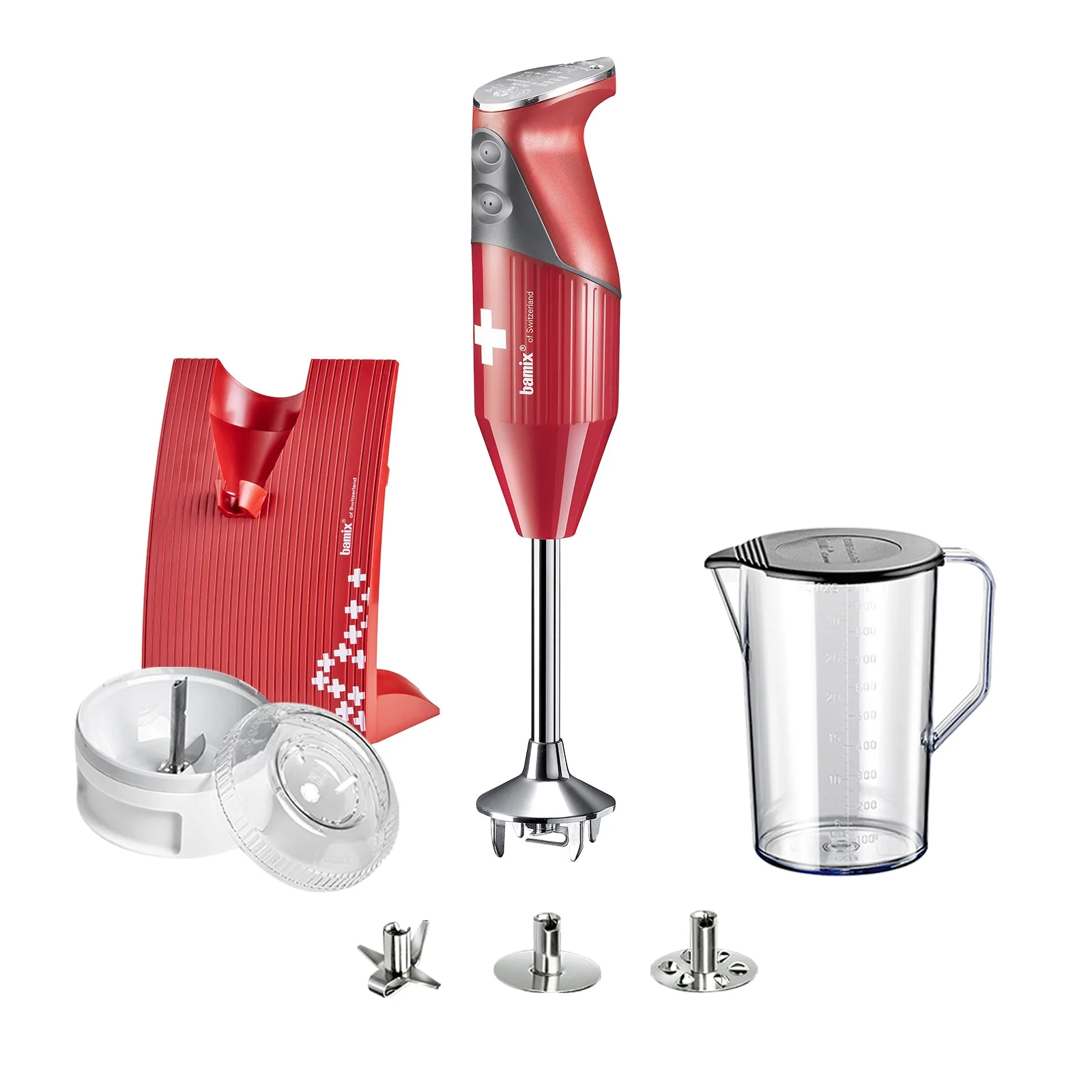
1. Bamix Gastro Pro-2 — Best Overall ($259)
The Bamix Gastro Pro-2 is built for commercial kitchens and made in Switzerland. The 200W AC motor is quieter than any DC motor we tested and delivers consistent torque at both speeds (12,000 and 17,000 RPM). The 7.4" shaft is chromated brass — heat-resistant, odor-resistant, and immersion-safe in boiling liquid.
The good: Three included blades (multi-purpose, beater/aerating, whisk/blender) that swap in seconds without tools. The open mixing head design pulls ingredients down into the blade rather than pushing them away — it blends faster and doesn’t suck to the bottom of the pot. Motor has a lifetime warranty. The build quality is visibly better than everything else — it feels like a tool, not an appliance.
The bad: Expensive — $259 is 5x the Cuisinart. Only two speeds (no variable speed dial). No jar or container included (comes with a wall bracket). The trigger guard safety button is awkward at first.
Price: $259. Check Price → Verdict: Buy this if you cook daily and want one immersion blender for life. The lifetime warranty makes the upfront cost a long-term savings.
2. Breville Control Grip BSB510XL — Best Premium ($80)
Breville’s Control Grip fixes the main problem with immersion blenders: suction. The bell-shaped base with internal ribbing reduces the vacuum seal that usually happens when you press the blender into food. You can hold it at any angle without the blade getting stuck against the pot.
The good: 280W motor with 15 variable speeds via a trigger — squeeze harder for more power. 8" shaft reaches deep into stockpots. The trigger grip is more natural than top-button designs. Anti-suction works exactly as advertised. Comes with a 42oz jug, 25oz chopper bowl, and whisk attachment. The jug houses the chopper bowl for compact storage.
The bad: The trigger takes a few sessions to get used to — it’s easy to accidentally max speed. Chopper attachment is OK but not as good as a dedicated mini processor. Plastic shaft (blade is stainless steel, but the shaft is not).
Price: $80. Check Price → Verdict: Best immersion blender for home cooks who want variable speed and anti-suction. The best value at this price.
3. Cuisinart CSB-179 Smart Stick — Best Value ($55)
The Cuisinart CSB-179 is the most popular immersion blender on Amazon for good reason. 300W DC motor, variable speed slide control, 8" stainless steel shaft. Three attachments: 3-cup chopper/grinder, chef’s whisk, and 2-cup mixing cup.
The good: Variable speed is controlled by a slide switch — intuitive and easy to adjust mid-blend. The DC motor is quieter than similarly priced competitors. Chop/grind attachment actually works for nuts and hard cheese. The whisk makes decent whipped cream. Comfortable rubberized handle with a lock button for safety.
The bad: The slide switch feels a bit loose after a year. Suction is noticeable when pureeing thick soups — you need to rock it gently. Mixing cup is too small (2 cups) and has no measurement markings. The 3-year warranty is good but Cuisinart customer service is slow.
Price: $55. Check Price → Verdict: 90% of the performance for 20% of the Bamix price. The smart choice for most home kitchens.
4. KitchenAid KHB1231 — Best Budget ($45)
The KitchenAid KHB1231 is a no-nonsense 2-speed immersion blender. Fixed S-blade, 8" removable blending arm, soft-grip handle, 3-cup BPA-free jar with lid. Nothing fancy, everything functional.
The good: Simple. Two clearly marked speeds — low for gentle blending, high for pureeing. The soft grip handle is comfortable. The removable arm makes cleaning straightforward. KitchenAid color options (Onyx Black, Empire Red, Contour Silver) match other KitchenAid appliances. At $45, it’s the cheapest option that still feels quality.
The bad: No variable speed — just two fixed speeds. No whisk or chopper attachment (the CSB-179 gives you both for $10 more). The fixed S-blade is less effective than the multi-purpose blade on the Bamix or the bell design on the Breville. Struggles with thick mixtures. 2-speed means you sometimes want something between low and high.
Price: $45. Check Price → Verdict: Good for occasional use — making a few smoothies per week or blending soup once a month. If you blend more often, spend $10 more for the Cuisinart.
5. All-Clad KZ750D — Best Splurge ($150)
The All-Clad KZ750D is the most powerful immersion blender we tested. 600W motor with variable speed dial and a turbo button. The 9.25" shaft is the longest in this test. The entire shaft is stainless steel, including the blade guard.
The good: 600W makes quick work of anything — frozen fruit, thick root vegetable soup, fibrous greens. The turbo button gives a full-power burst that handles jams. The extra-long shaft reaches the bottom of full 8-quart stockpots without submerging the motor housing. All-Clad build quality: all metal, no plastic in the shaft or blending bell. Detachable shaft for easy cleaning.
The bad: Heavy (2.8 lbs) — noticeably heavier than the Cuisinart (1.5 lbs) and KitchenAid (1.2 lbs). The variable speed dial is on the body, not the handle — you need two hands to adjust. No attachments included (no whisk, no chopper, no jar). Expensive at $150.
Price: $150. Check Price → Verdict: Best for serious home cooks who regularly puree large batches. The 600W motor and 9.25" shaft justify the price if you make soup by the gallon.
Comparison Table
| Feature | Bamix Gastro | Breville Control Grip | Cuisinart CSB-179 | KitchenAid KHB1231 | All-Clad KZ750D |
|---|---|---|---|---|---|
| Price | $259 | $80 | $55 | $45 | $150 |
| Wattage | 200W AC | 280W | 300W DC | — | 600W |
| Speeds | 2 | 15 (variable) | Variable slide | 2 | Variable + turbo |
| Shaft length | 7.4" | 8" | 8" | 8" | 9.25" |
| Shaft material | Chromated brass | Stainless steel blade | Stainless steel | Stainless steel | Stainless steel |
| Attachments | 3 blades | Jug, chopper, whisk | Chopper, whisk, cup | Jar with lid | None |
| Weight | 2.2 lb | 5.7 lb (with accessories) | 1.5 lb | 1.2 lb | 2.8 lb |
| Dishwasher safe | Yes | Yes (blade) | Yes (shaft) | Yes (arm) | Yes (shaft) |
| Warranty | Lifetime (motor) | 1 year | 3 year | 1 year | 2 year |
Bottom Line
Best all-around: Bamix Gastro Pro-2 ($259) — buy once, cry once. For home cooks: Breville Control Grip ($80) — anti-suction is a game-changer. Best value: Cuisinart CSB-179 ($55) — does everything well. Budget pick: KitchenAid KHB1231 ($45) — simple, cheap, reliable. For large batches: All-Clad KZ750D ($150) — most powerful motor, longest shaft.
See how immersion blenders compare to countertop blenders → Immersion vs Countertop Blender
FAQ
Can an immersion blender replace a countertop blender? Partially. Immersion blenders are better for hot soups (blend in the pot), smaller quantities, and emulsifications. Countertop blenders are better for frozen smoothies, crushing ice, and large batches with fibrous ingredients. Most homes need both. See our full comparison →
Can you use an immersion blender in a nonstick pot? Yes, most immersion blenders have a smooth bell housing that will not scratch nonstick. But you must keep it parallel to the bottom — never tilt and scrape with the blade edge. The All-Clad and Breville have the safest bell designs for nonstick.
How do you clean an immersion blender? Best method: fill a tall cup with warm water and a drop of soap, submerge the shaft, and run it for 10 seconds. The blades self-clean. Rinse and dry. Never submerge past the maximum immersion line on the shaft.
What can you make with an immersion blender? Soup (any soup), mayonnaise (30 seconds), hollandaise, smoothies, baby food, salad dressing, whipped cream, milkshakes, pesto, tomato sauce, and hummus. The Bamix and Cuisinart chopper attachments also grind nuts, herbs, and hard cheese.
Is a cordless immersion blender worth it? Only if you regularly cook in places without nearby outlets (campsite, outdoor kitchen, very large kitchen). Cordless models are weaker, heavier, and the battery degrades. For most kitchens, corded gives better performance for the price.
Prices and availability subject to change. We may earn a commission through affiliate links.