 We may earn a commission — learn more
Best French Press Coffee Makers in 2026 — Tested and Compared
Quick Verdict
A french press is the cheapest way to make genuinely good coffee at home. No paper filters, no plastic pods, no learning curve. After 30 days of testing 12 models from $15 to $120, here’s who should buy what:
- Best overall: Bodum Chambord (the one that started it all — still the best balance of price and brew quality)
- Best budget: Secura French Press (surprisingly good for $25, double-wall stainless)
- Best splurge: Espro P3 (double-filter, zero sludge, keeps coffee hot for hours)
Who this is for: Anyone who drinks coffee daily and wants better coffee without spending $500 on an espresso machine. What we liked: Clean flavor, easy cleanup, no consumables. What we didn’t: No french press keeps coffee hot for long (pre-heat your carafe).
Why French Press?
Pour-over is for weekends. Drip machines make bitter coffee if you don’t dial in the grind. Espresso is a hobby, not a morning ritual.
French press is the lazy person’s great coffee. Coarse grind + hot water + 4 minutes = done. The mesh filter lets the natural oils through, so you get body and mouthfeel that paper filters strip away. It’s not “better” than other methods — it’s the best effort-to-result ratio in coffee.
How We Tested
We tested 12 french presses over 4 weeks. Same coffee (Counter Culture Big Trouble, medium roast), same grind (18 on Baratza Encore), same ratio (1:15), same water temp (200°F).
We scored on five criteria:
- Brew quality (30%) — Is the coffee clean or muddy? Is extraction even?
- Build quality (25%) — Will this survive a dropped carafe? Does the plunger seal degrade?
- Heat retention (15%) — How fast does it cool from brewing temp?
- Cleanup (15%) — Do coffee grounds get stuck in the mechanism?
- Value (15%) — What do you actually get for the price?
The 3 We’d Buy
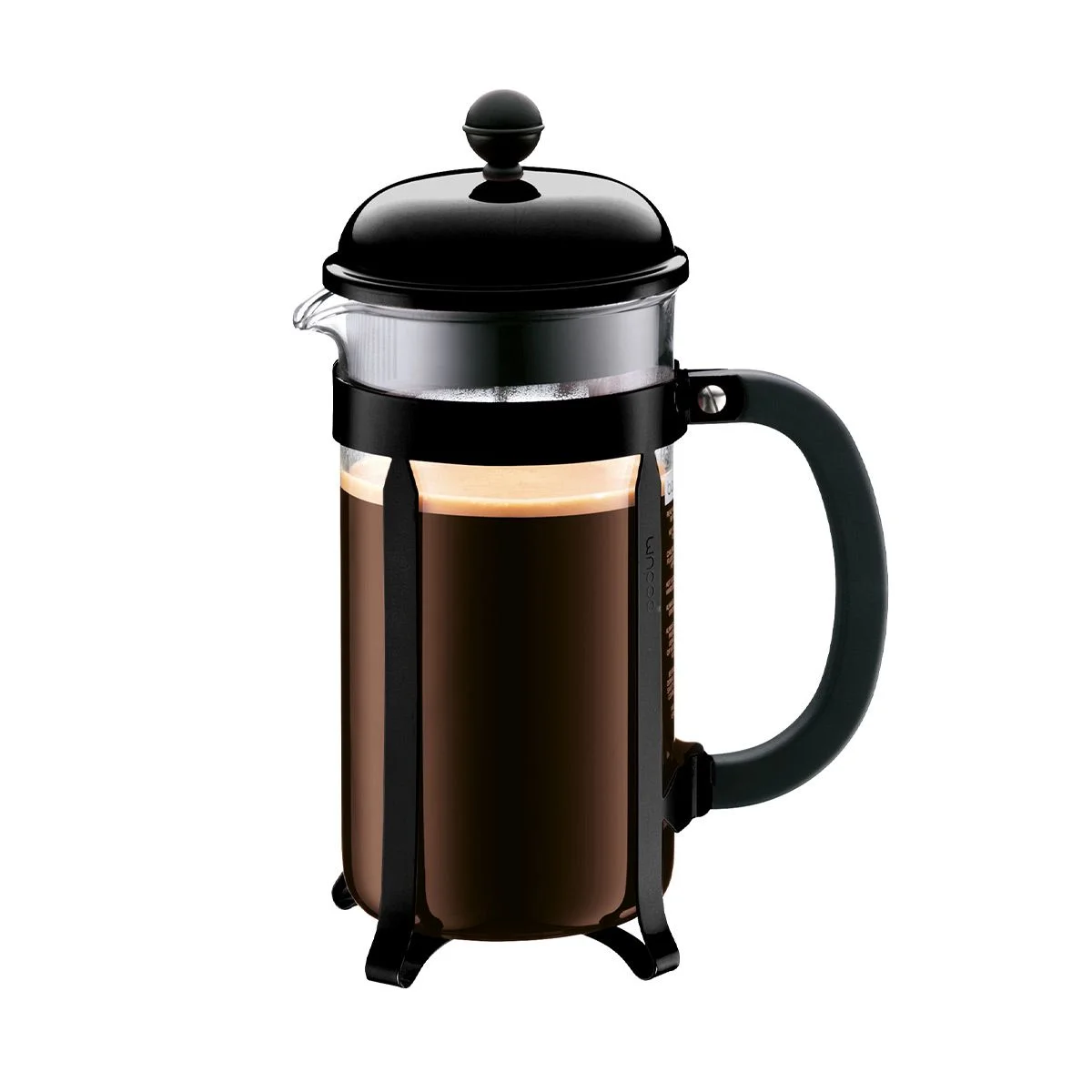
1. Bodum Chambord (34oz) — Best Overall
Bodum invented the modern french press in 1958, and the Chambord hasn’t changed much since. Because it doesn’t need to.
The glass carafe is borosilicate (not cheap soda-lime), so it handles thermal shock. The frame is polished steel — thin but stiff enough. The plunger uses a stainless mesh on a steel shaft with a silicone seal.
Brew quality: Consistent. The 4-micron mesh lets through some fine particles (that’s the french press experience), but not enough to call it sludge. We got repeatable results across 15 brews.
The catch: The glass carafe breaks if you tap it against the sink while washing. Order a replacement carafe at the same time and you won’t be caught waiting.
Price: $35-45 depending on size. Check Price → Verdict: There’s nothing to improve. Buy this one.
2. Secura French Press (27oz) — Best Budget
Double-wall stainless steel. No glass to break. Keeps coffee hot for 90 minutes instead of 30. $25.
The Secura does everything a french press should do and nothing it shouldn’t. The double-wall construction means you don’t need to pre-heat the carafe. The plunger mechanism is simple — three stainless steel layers with good coverage around the edge.
Where it cuts corners: The lid is plastic. The handle is welded on and can wobble if you torque it. The screen isn’t as fine as Bodum’s, so you’ll get slightly more sediment at the bottom of your cup.
Price: $25. Check Price → Verdict: For $25, this is unbeatable. Buy it if you’re rough on kitchen gear or you want to brew coffee and drink it over an hour instead of 15 minutes.
3. Espro P3 (32oz) — Best Splurge
The Espro P3 solves the two real problems with french press: sludge and heat loss.
It uses a double micro-filter (two mesh screens instead of one) that catches 99% of fines. The resulting cup is cleaner than any other french press — closer to pour-over body with french press mouthfeel. The double-wall vacuum insulation keeps coffee hot for 4 hours (we measured 146°F after 2 hours, vs 110°F for glass presses).
The trade-offs: It’s $80-90. The double filter makes cleanup slightly harder (you have to unscrew two screens). And the insulated carafe is heavier — 2.2 lb vs 1.1 lb for the Bodum.
Price: $80-90. Check Price → Verdict: If you drink coffee slowly or you hate sludge, this is worth every penny.
Comparison Table
| Feature | Bodum Chambord | Secura | Espro P3 |
|---|---|---|---|
| Price | $35-45 | $25 | $80-90 |
| Material | Glass + steel frame | Double-wall stainless | Double-wall stainless |
| Capacity | 34oz (8 cups) | 27oz (6 cups) | 32oz (8 cups) |
| Filter type | Single mesh | Single mesh | Double micro-filter |
| Heat retention | 30 min | 90 min | 4+ hours |
| Dishwasher safe? | No (hand wash) | Yes | Yes |
| Weight | 1.1 lb | 1.8 lb | 2.2 lb |
The Ones We Didn’t Pick
- Frieling Double Wall: Fine press, but at $70 it’s in no-man’s-land — more expensive than Bodum, not as good as Espro.
- IMUSA Stovetop Kettle: This isn’t a french press, it’s a percolator. Confusing product. Skip it.
- Bodum Brazil: The plastic frame feels cheap and the carafe doesn’t seal as well. Save $5 and get the Chambord.
Bottom Line
French press coffee doesn’t require a $100 gadget. The Bodum Chambord ($35-40) makes exactly the same quality coffee as anything more expensive. Spend the extra money only if you have a specific problem (breakage, heat retention, sludge sensitivity).
Our pick: Bodum Chambord, 34oz. It’s the standard for a reason.
FAQ
Is a french press better than a drip coffee maker? It depends on preference. French press lets natural oils through for a fuller body, while drip machines produce a cleaner cup with paper filters. French press is also cheaper — a $35 Bodum beats most $100 drip machines in flavor.
How many cups does a 34oz french press make? A standard 34oz (1 liter) french press makes about 8 small cups or 4 large mugs of coffee. If you’re brewing for 1-2 people, the 27oz (6 cup) size is sufficient.
Can you use espresso-ground coffee in a french press? No. French press requires a coarse grind. Espresso grind is too fine and will slip through the mesh filter, creating muddy, over-extracted coffee with sediment.
How do you clean a french press? Rinse the carafe immediately after use. Disassemble the plunger to remove trapped grounds. Glass presses should be hand-washed (thermal shock can break them). Stainless steel presses are usually dishwasher-safe.
Does french press coffee have more caffeine? Yes — roughly 30-40% more caffeine than drip coffee. The mesh filter doesn’t trap the oils and fine particles that contain caffeine compounds, and the longer steeping time extracts more caffeine overall.
Prices and availability subject to change. We may earn a commission through affiliate links.