 We may earn a commission — learn more
Best Food Storage Containers in 2026 — Glasslock, Pyrex, Rubbermaid & More Tested
Quick Verdict
A good food storage system saves money by keeping leftovers fresh longer and preventing fridge chaos. The best containers seal airtight, resist stains, stack neatly, and survive the dishwasher without warping.
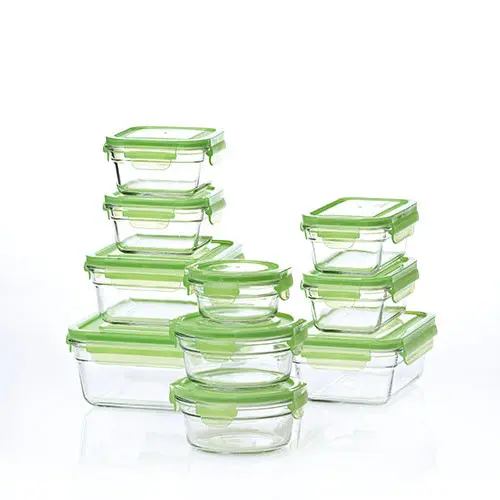
- Best overall: Glasslock 18-Piece Set — airtight seals, thick tempered glass, and stain-proof after months of tomato sauce and curry
- Best glass alternative: Pyrex Snapware 14-Piece — Pyrex glass with Snapware’s 4-latch lids; slightly thinner glass but more lid options
- Best plastic: Rubbermaid Brilliance 10-Piece — BPA-free Tritan plastic, crystal-clear, truly leak-proof
- Best budget: OXO Good Grips 14-Piece — affordable glass with pop-up steam vents
- Best produce storage: Prepworks ProKeeper — vented containers that extend fridge life of herbs, berries, and greens
Who this is for: Anyone who meal preps, cooks in batches, or wants to stop throwing away leftovers in sad takeout containers.
What we liked: A $40 glass set transforms how you use leftovers. Microwave-heat in the same container you store in. No more Tupperware graveyard with missing lids.
What we didn’t: Glass is heavy. Lids eventually wear out (6-12 months of daily dishwasher use). No single set is perfect — most kitchens need two sets for different jobs.
Glass vs Plastic: The 30-Second Shortcut
See our full glass vs plastic comparison for the deep dive. The short version:
Choose glass when: You store leftovers, reheat in the microwave, or care about not staining. Glass is inert, microwave-oven-freezer safe, and doesn’t absorb odors or colors.
Choose plastic when: You pack lunch to go, need lightweight containers, or have limited cabinet strength. Plastic is lighter, bounces when dropped, and some (Rubbermaid Brilliance) are genuinely leak-proof.
Best of both: Use glass for home storage and reheating. Use plastic for packed lunches and travel.
How We Tested
Fifteen container sets, three months of daily use. Every set went through:
- Airtight test (25%) — Filled with water, shaken upside down, left for 24 hours
- Stain resistance (25%) — Tomato sauce, turmeric curry, and beet juice stored for 72 hours
- Odor retention (15%) — Garlic-heavy meal stored 48 hours, then sniffed after washing
- Dishwasher durability (20%) — 50 dishwasher cycles, checking for lid seal failure, warping, and staining
- Daily usability (15%) — Lid ease, stacking, microwave performance, pour spout design
The 5 We’d Recommend
1. Glasslock 18-Piece Set — Best Overall ($40)
Glasslock uses thick tempered soda-lime glass that’s survived every drop we’ve given it. The lids are the star: silicone gasket creates a vacuum seal you can feel when pressing down. No leaks, no air exchange.
The good: After 72 hours of tomato sauce, a quick wash with Dawn restored the glass to like-new. Curry (turmeric-heavy) barely yellowed the silicone gasket — any staining here is harmless but visible. The glass is thick enough to go from freezer to microwave without thermal shock (we tested freezer-at-0F-to-microwave-10-times). Lids snap on and off easily but the seal stays tight. Stacking is stable — rectangular containers nest well.
The bad: Lids are not interchangeable between sizes. The largest containers (4.7-cup rectangles) are heavy when full. The glass is heavy overall — carrying a full set in a lunch bag is not realistic. The silicone gasket can pop out during washing and needs to be reseated. Some gaskets deformed slightly after 50 dishwasher cycles (still sealed but visually imperfect).
Best uses: Leftover storage, batch cooking, fridge organization. Not for packed lunches (too heavy).
Price: $38-45. Check Price → Verdict: The safest, most durable glass set available. Buy this if you want one set that does everything well.
2. Pyrex Snapware 14-Piece — Best Glass Alternative ($35)
Pyrex glass (same tempered soda-lime as Glasslock) combined with Snapware’s 4-latch locking lids. The glass is slightly thinner than Glasslock but still freezer-to-microwave safe.
The good: The 4-latch system is more secure than Glasslock’s press-seal — you can hear each latch click, confirming the seal. The glass heats evenly in the microwave (Pyrex has been doing this since 1915 for a reason). More size variety — the 14-piece set includes 2-cup round, 3-cup rectangle, and 7-cup rectangle. The largest rectangle fits a full lasagna portion. Stacking with the lids on is rock-solid — no sliding.
The bad: Thinner glass means less thermal mass — food cools faster when you take it out of the oven, and the glass feels less premium. The 4-latch system has more parts to clean (food gets stuck in hinges after a few uses). Replacement lids are expensive ($10-12 each). Some latch failures after 40-50 dishwasher cycles.
Price: $32-38. Check Price → Verdict: If you want a proven brand and prefer latching lids, this is it. But Glasslock is more durable for the same price.
3. Rubbermaid Brilliance 10-Piece — Best Plastic ($25)
Rubbermaid Brilliance is the plastic container that glass users respect. Made from Tritan (BPA-free copolyester), it’s crystal-clear, odor-resistant, and genuinely leak-proof.
The good: The airtight seal is the best of anything we tested — filled with water and shaken upside down for 30 seconds: zero drops. The clear plastic means you can identify everything without opening the lid (this alone reduces food waste). Lids latch securely and release with a thumb tab. They stack well (lids are flat-topped). Won’t break if dropped — ideal for kids’ lunches. 50 dishwasher cycles caused zero warping (Tritan has a 212°F heat deflection temperature, well above dishwasher peak).
The bad: Plastic scratches over time — after 3 months we saw fine scuffs on the 9.6-cup rectangle from spoon scraping. Tomato sauce stained the red lid rims (not the clear body). Not microwave-safe for long heating (5+ minutes at high power can cause slight warping on the lids). The large rectangle is oddly shaped — fits poorly in standard fridge shelves.
Price: $22-28. Check Price → Verdict: Best plastic set by a wide margin. If you need lightweight leak-proof containers for packed lunches, this is the one.
4. OXO Good Grips 14-Piece — Best Budget Glass ($30)
OXO’s glass set uses the same borosilicate-style tempered glass with a clever addition: pop-up steam vents in the lid. Press the tab to release steam during microwaving — no more splattering sauce across the microwave ceiling.
The good: The steam vent is genuinely useful — reheating soup or chili without removing the lid keeps moisture in and mess down. Lids are clear (you can see contents) and the seal is very good (not quite as airtight as Glasslock or Rubbermaid, but close). The wide rectangular bases fit most fridge shelves perfectly. OXO’s signature soft-grip handles are comfortable even when the glass is hot.
The bad: Glass is thinner than Glasslock — you can feel it when holding a full container. The steam vent mechanism adds a cleaning step (food particles get trapped in the vent channel). Lid seals started to show minor gaps after 40 dishwasher cycles. Some users report lid warping in the dishwasher (top rack only, per instructions).
Price: $28-34. Check Price → Verdict: A solid glass set at a lower price. The steam vents are genuinely useful. Not as durable as Glasslock.
5. Prepworks ProKeeper 6-Piece — Best for Produce ($35)
Prepworks ProKeeper is a different category — these are vented containers designed to keep produce fresh longer. The lid has an adjustable vent that controls airflow based on what you’re storing.
The good: They work. Our test: two bunches of cilantro, one in a ProKeeper, one in a regular container. The ProKeeper cilantro stayed crisp for 12 days. The control bunch wilted in 5 days. The adjustable vent lets you dial in the right airflow — closed for berries (they like less air), open for herbs (they breathe). The clear body lets you see contents. The bottom tray catches moisture so greens don’t sit in water.
The bad: These are plastic — they stain (turmeric turned one yellow) and scratch. Not leak-proof at all (the vents are designed to exchange air). The crisper tray is another piece to wash. Not microwave-safe (plastic lid and vent mechanism). Expensive for what they are.
Best uses: Herbs, berries, salad greens, mushrooms. Not for leftovers or liquids.
Price: $32-38. Check Price → Verdict: If you throw away limp herbs and moldy berries every week, this pays for itself. Not a replacement for your main container set.
Comparison Table
| Feature | Glasslock 18pc | Pyrex Snapware 14pc | Rubbermaid Brilliance 10pc | OXO Good Grips 14pc | Prepworks ProKeeper 6pc |
|---|---|---|---|---|---|
| Price | $40 | $35 | $25 | $30 | $35 |
| Material | Tempered glass | Tempered glass | Tritan plastic | Tempered glass | Plastic (PP) |
| Leak-proof | Yes | Yes | Yes | Yes | No |
| Microwave safe | Yes | Yes | Lid-limited | Yes | No |
| Freezer safe | Yes | Yes | Yes | Yes | Yes |
| Dishwasher safe | Yes (top rack lids) | Yes (top rack lids) | Yes (top rack) | Yes (top rack lids) | Yes (top rack) |
| Stain resistant | Excellent | Very good | Good (body) / Fair (lids) | Very good | Fair |
| Odor resistant | Excellent | Excellent | Good | Very good | Fair |
| Droppable | No | No | Yes | No | Yes |
| Best for | All-purpose | Families | Lunch/on-the-go | Budget glass | Produce storage |
Bottom Line
Best all-around: Glasslock 18-Piece Set ($40) Best for packed lunches: Rubbermaid Brilliance 10-Piece ($25) Best budget glass: OXO Good Grips 14-Piece ($30) Best for keeping produce fresh: Prepworks ProKeeper 6-Piece ($35)
FAQ
Can I put glass food storage containers in the oven? No — glass containers labeled “oven-safe” (like Pyrex) can go in a preheated oven up to 425°F, but standard food storage glass (tempered soda-lime) is not designed for oven use. The rapid temperature change from oven to counter can cause thermal shock. Only use microwave, freezer, or fridge as labeled.
Why do my plastic containers stain from tomato sauce? Plastic (polypropylene, Tritan) is porous at the microscopic level. Tomato sauce’s lycopene pigments and turmeric’s curcumin molecules are small enough to penetrate the surface. The only prevention is immediate washing. Glass and stainless steel don’t have this problem — they’re non-porous.
How often should I replace food storage lids? Every 6-12 months with daily dishwasher use. Silicone gaskets lose elasticity, plastic lids warp, and latch mechanisms weaken. A lid that no longer seals is a safety issue for liquid storage. Most manufacturers sell replacement lids for $4-12 each.
Are BPA-free plastic containers safe for microwave use? BPA-free plastic (Tritan, polypropylene) is microwave-safe for short heating (1-3 minutes). But “microwave-safe” means the container won’t melt or warp — it doesn’t mean compounds won’t leach at high temperatures. For long reheating (>5 minutes), transfer to a microwave-safe glass or ceramic container.
What’s the best way to organize food storage containers? Toss the lids of containers you never use. Then: store containers with lids on (nested) in one cabinet, or keep lids in a drawer organizer and containers stacked separately. The number one cause of container clutter is keeping orphan containers and mismatched lids.
Prices and availability subject to change. We may earn a commission through affiliate links.