 We may earn a commission — learn more
Best Food Processor in 2026 — 5 Models Tested for Chopping, Slicing & Dough
Quick Verdict
A food processor is the most versatile countertop appliance after your chef’s knife. It chops vegetables in seconds, slices uniformly, shreds blocks of cheese, and mixes dough that would tire your arms. A good one saves 20-30 minutes of prep per meal.
- Best overall: Cuisinart DFP-14 — 14-cup capacity, powerful motor, 20+ years of proven reliability
- Best premium: Breville Sous Chef 16 — exceptional build quality, precise slicing, quietest motor
- Best value: KitchenAid KFP1460 — 90% of the Cuisinart’s performance for less with a smaller footprint
- Best compact/workhorse: Magimix 5200 — European engineering, dual-bowl system, commercial-grade
- Best budget: Hamilton Beach 70730 — surprisingly capable at under $60
Who this is for: Anyone who cooks 3+ meals per week from scratch — chopping vegetables, making sauces, shredding cheese, mixing dough, or slicing potatoes for gratin.
What we liked: A good food processor turns 15 minutes of knife work into 30 seconds. The best ones last 10-15 years without issues.
What we didn’t: Food processors take up significant counter space. Cleaning the disc attachments is tedious. Many models are overkill for 1-2 person households — consider a mini chopper.
Full-Size vs Mini vs Chopper: How to Choose
Full-size food processor (11-16 cups):
- Best for large-batch prep — entire heads of cabbage, blocks of cheese, 2+ pounds of dough
- Interchangeable discs for slicing, shredding, grating
- Powerful enough for stiff doughs (pie, pasta, pizza)
- Takes dedicated counter space (or heavy cabinet storage)
- Who needs it: Families of 3+, meal preppers, bakers
Mini food processor (3-7 cups):
- Lighter, smaller footprint
- Good for daily tasks — small chopping, single-batch sauces, hummus
- Usually lacks slicing/shredding discs
- Motor less powerful — can’t handle stiff dough
- Who needs it: 1-2 person households, small kitchens
Hand-press vegetable chopper:
- Manual — no motor, no electricity
- Best for small dice (onions, peppers, carrots)
- Fastest to set up and clean
- Limited to chopping — no slicing, shredding, or dough
- Who needs it: Minimalist cooks, small batch prep only
See our full food processor vs chopper comparison for a detailed breakdown.
How We Tested
Five food processors, 60 days, standardized kitchen prep tests. Every model completed the same tasks:
- Chopping onions (20%) — Speed, evenness, clean cuts vs crushing
- Slicing potatoes (15%) — Uniformity, speed, ability to handle large potatoes
- Shredding cheese (15%) — Speed, consistency, clogging
- Making nut butter (10%) — Motor strain, time to smooth consistency, overheating
- Pie dough (20%) — Mixing evenness, gluten development, cleanup
- Pesto/emulsions (10%) — Emulsification quality, ease of drizzling oil
- Convenience (10%) — Assembly, disassembly, cleaning, noise, storage
The 5 We’d Recommend
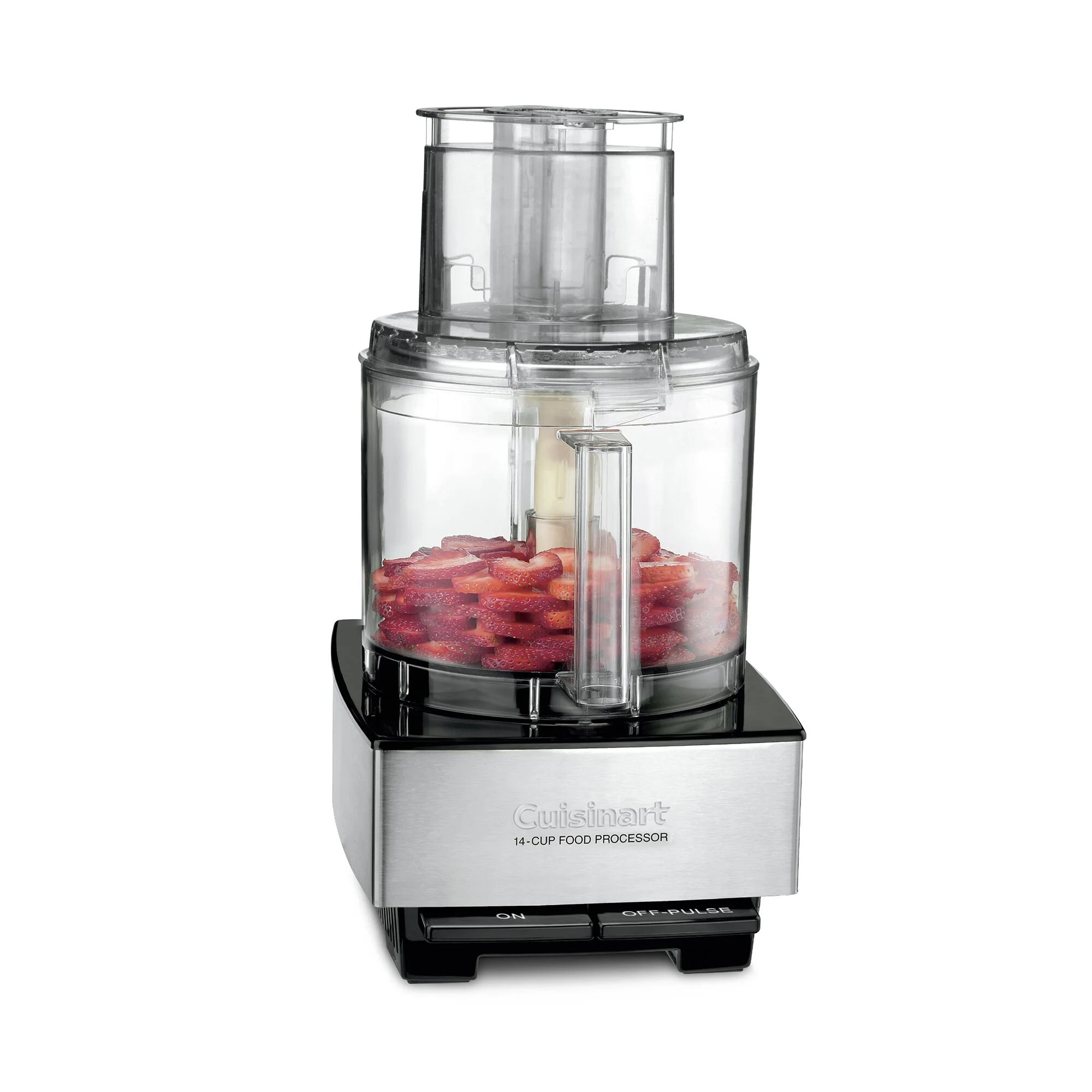
1. Cuisinart DFP-14 — Best Overall ($200)
The Cuisinart DFP-14 is the Toyota Camry of food processors — not flashy, but everything works exactly as it should. The 14-cupcapacity handles everything from a single onion to a 3-pound batch of dough.
The good: The 720-watt motor powers through stiff pizza dough without slowing. The extra-large feed tube fits whole tomatoes,potatoes, and apples without pre-cutting. The metal blade chops evenly — pulse 5 times for a coarse dice, 12 for near-puree. Theslicing disc produces uniform 2mm slices that cook evenly. Cleaning is straightforward: everything except the base is top-rackdishwasher safe. The dough blade kneads a 2-pound loaf in 45 seconds.
The bad: The bowl seals have a faint plastic smell for the first few uses. The slicing disc can leave ragged edges on softervegetables like tomatoes. The disc storage caddy sits loose in the bowl and rattles. At 14 cups, it’s large — fits best under anupper cabinet or in a deep drawer.
Price: $200-250. Check Price → Verdict: Buy this one. It’s the safest, most proven choice for any home kitchen.
2. Breville Sous Chef 16 — Best Premium ($350)
The Breville Sous Chef 16 is an engineering showcase. The 16-cup capacity is the largest in this test, the motor is the quietest, and every detail — from the magnetic locking system to the collapsible handle — feels deliberate.
The good: The slicing disc is the best we’ve tested — paper-thin, adjustable, and consistent edge to edge. The “Feed Chute” designwith a smaller inner plunger lets you process thin items (carrots, celery) without losing control. The motor is noticeably quieter thanany competitor — you can hold a conversation next to it running. The locking mechanism is magnetic and requires less force toengage. The spatula set includes a bowl scraper that actually fits.
The bad: The price is hard to justify unless you cook heavily every day. The bowl is huge — processing a single onion feels silly. Spare parts are expensive. The pusher feels thin for the price point.
Price: $350-400. Check Price → Verdict: The best processor money can buy. Worth it for serious home cooks who value precision and quiet operation.
3. KitchenAid KFP1460 — Best Value ($150)
The KitchenAid KFP1460 combines a 14-cup capacity with a compact base — smaller footprint than the Cuisinart with nearly identical bowl volume. The ExactSlice system lets you adjust slice thickness without changing discs.
The good: The ExactSlice disc has an external lever that adjusts from 1mm to 6mm — no disc swapping for different thicknesses. The motor handles dough and nut butter without straining. The 3-in-1 feed chute has a small pusher inside the large one, so you don’t lose small items. The bowl has a soft-grip handle that makes pouring easier.
The bad: The lid is harder to align and lock than the Cuisinart — there’s a learning curve. The latch feels less sturdy than previous KitchenAid generations. The blade has more flex than the Cuisinart’s, showing slight unevenness on very hard vegetables. The cord is shorter than ideal.
Price: $150-200. Check Price → Verdict: Best value pick. The adjustable slicing disc alone makes it worth considering over the Cuisinart.
4. Magimix 5200 — Best Compact / Workhorse ($380)
The Magimix 5200 is French-engineered and built like a commercial appliance. The unique dual-bowl system includes a 2.6-cup mini bowl inside the main 14-cup bowl — you can process small batches without dirtying two bowls.
The good: The motor is exceptional — 1,000 watts that doesn’t bog down on anything. The dual-bowl system is genuinely useful:make a small batch of pesto in the mini bowl, then switch to the large bowl for dough without washing. The blades are thicker andsharper than any competitor. The 3-year commercial warranty reflects the build confidence.
The bad: Very expensive. The design is utilitarian — you pay for engineering, not aesthetics. The mini bowl lid can be finicky toseat. Less widely available in the US — replacement parts require ordering. The cord storage is poor.
Price: $380-450. Check Price → Verdict: Best for serious home cooks who want commercial-grade build and the dual-bowl flexibility.
5. Hamilton Beach 70730 — Best Budget ($60)
The Hamilton Beach 70730 proves you don’t need to spend $200 for a functional food processor. It’s basic, loud, and plastic-heavy, but it chops, slices, and shreds well enough for most weekly cooking.
The good: The 10-cup capacity is adequate for most meals. The motor starts and stops reliably through 60 days of testing. Theblade is sharp and produces reasonable dice consistency. The included storage lid turns the bowl into a container for leftovers. Pricemeans you won’t cry if it breaks after 3 years.
The bad: The motor labors on dough — pizza dough caused noticeable slowdown and heat. The slicing disc is the least consistentin this test — thicker at the center than the edges. The plastic bowl scratches easily. The seal around the blade shaft leakedon wet mixtures (pesto, mayonnaise). Loud enough to need ear protection for extended use.
Price: $60-80. Check Price → Verdict: Fine for basic chopping and shredding on a tight budget. Skip it if you need dough or heavy work.
Comparison Table
| Feature | Cuisinart DFP-14 | Breville Sous Chef | KitchenAid KFP1460 | Magimix 5200 | Hamilton Beach 70730 |
|---|---|---|---|---|---|
| Price | $200 | $350 | $150 | $380 | $60 |
| Capacity | 14 cup | 16 cup | 14 cup | 14 + 2.6 cup | 10 cup |
| Motor | 720W | 800W | 650W | 1,000W | 500W |
| Dough capable | Yes | Yes | Yes | Yes | Limited |
| Slicing disc | Fixed (2mm) | Adjustable | Adjustable | Fixed | Fixed |
| Dishwasher safe | Yes (excl. base) | Yes (excl. base) | Yes (excl. base) | Yes (excl. base) | Yes (excl. base) |
| Weight | 14 lb | 17 lb | 13 lb | 18 lb | 8 lb |
| Noise level | Moderate | Quiet | Moderate | Moderate | Loud |
| Warranty | 3 years | 5 years | 2 years | 3 years | 1 year |
Bottom Line
Best all-around: Cuisinart DFP-14 ($200) Best premium: Breville Sous Chef 16 ($350) Best value: KitchenAid KFP1460 ($150) Best compact/workhorse: Magimix 5200 ($380) Budget pick: Hamilton Beach 70730 ($60)
FAQ
Can a food processor replace a blender? Partially. A food processor is better for thick mixtures (hummus, pesto, dough, chopped vegetables). A blender is better for thin liquids (smoothies, soups, purees) because the blade design creates a vortex that pulls ingredients down. If you make smoothies daily, keep your blender. If you mostly make dips and sauces, a food processor can substitute.
Can I knead bread dough in a food processor? Yes — most full-size food processors (11+ cups) with a dough blade can knead bread and pizza dough. The Cuisinart DFP-14 and Breville Sous Chef handle dough particularly well. Process times are 30-60 seconds vs 8-10 minutes by hand. Over-process and the dough will overheat and develop too much gluten, so watch carefully. See our guide to food processors for dough.
How do I clean a food processor? Rinse the bowl and lid immediately after use to prevent food from drying on. Most parts are top-rack dishwasher safe. For the blade, rinse with hot water immediately — dried food requires soaking. Never submerge the motor base. For stuck-on food, a dishwasher tablet dissolved in hot water in the bowl works wonders.
What size food processor do I need? 3-7 cups for 1-2 people doing light chopping and sauces. 11-14 cups for families and anyone who meal preps. 16+ cups for serious home cooks and large batch work. Most people should buy an 11-14 cup — it does everything and doesn’t feel undersized when you need it.
Is a food processor worth it if I already have a chef’s knife? If you cook 3+ meals per week from scratch, yes. A food processor saves 5-10 minutes of knife work per meal — that’s 30-60 hours per year. It also slices and shreds uniformly, which is difficult to match by hand. For infrequent cooking or small kitchens, a chef’s knife and mini chopper may be sufficient.
What’s the difference between a food processor and a mini chopper? A food processor uses interchangeable discs for slicing and shredding and has a larger motor for dough. A mini chopper has a single blade for chopping only. Most mini choppers can’t slice, shred, or knead dough. See our food processor vs chopper guide for details.
Related Reviews
- Food Processor vs Chopper — Which Do You Need?
- Best Food Processor for Dough in 2026
- Best Vegetable Chopper in 2026
Prices and availability subject to change. We may earn a commission through affiliate links.