 We may earn a commission — learn more
Best Espresso Machine Under $500 in 2026 — 7 Machines Tested
Quick Verdict
An espresso machine under $500 is a compromise — you’re trading consistency and steam power for affordability. But a few machines make the trade-off worth it.
- Best overall: Breville Bambino Plus — fastest warm-up, best steam wand, most consistent shots at this price
- Best for beginners: De’Longhi Dedica EC685 — compact, forgiving, makes decent milk drinks
- Best classic: Gaggia Classic Pro — mod-friendly, repairable, but needs a better grinder
- Best value: CASABREWS 5700 — $140 and makes genuinely good espresso (with caveats)
Who this is for: Anyone who wants real espresso at home without spending $800+ on a machine.
What we liked: The Bambino Plus proves you can get good espresso for $400 if you pair it with a decent grinder.
What we didn’t: Every machine under $500 struggles with consistency. Temperature stability is the limiting factor, not pressure.
What $500 Actually Buys You
Espresso machine pricing follows a frustrating curve:
- Under $200: Thermoblock heating, pressurized baskets only (fake crema), inconsistent temperature. You can make milk drinks that taste fine, but straight espresso will disappoint.
- $200-400: PID temperature control starts appearing (huge difference). Better steam power. Single-wall baskets for real crema. This is the sweet spot — the Bambino Plus lives here.
- $400-500: You get a solenoid valve for backflushing, slightly better build quality, and (sometimes) a metal interior. But you’re still in “entry-level prosumer” territory.
- $500-800: PID + OPV + solenoid + brass boiler + 58mm group head. This is where serious home espresso starts. Below $500, you’re making milk drinks, not studying espresso.
The machine is only half the equation. A $400 Bambino Plus paired with a $150 grinder (Baratza Encore ESP) will make better espresso than a $1,000 machine with a $50 blade grinder. Budget for the grinder first.
How We Tested
Seven machines, 60 days, one kitchen. Every machine was tested on the same grinder (Baratza Sette 270) to isolate machine performance. We pulled 5 shots per machine and measured:
- Shot quality (30%) — Crema thickness, extraction evenness, taste (same beans throughout)
- Steam performance (20%) — Time to steam 6oz milk, microfoam quality
- Temperature stability (20%) — Consistency across 3 back-to-back shots
- Build quality (15%) — Materials, fit/finish, repairability
- Ease of use (15%) — Warm-up time, workflow, cleaning difficulty
The 4 We’d Recommend
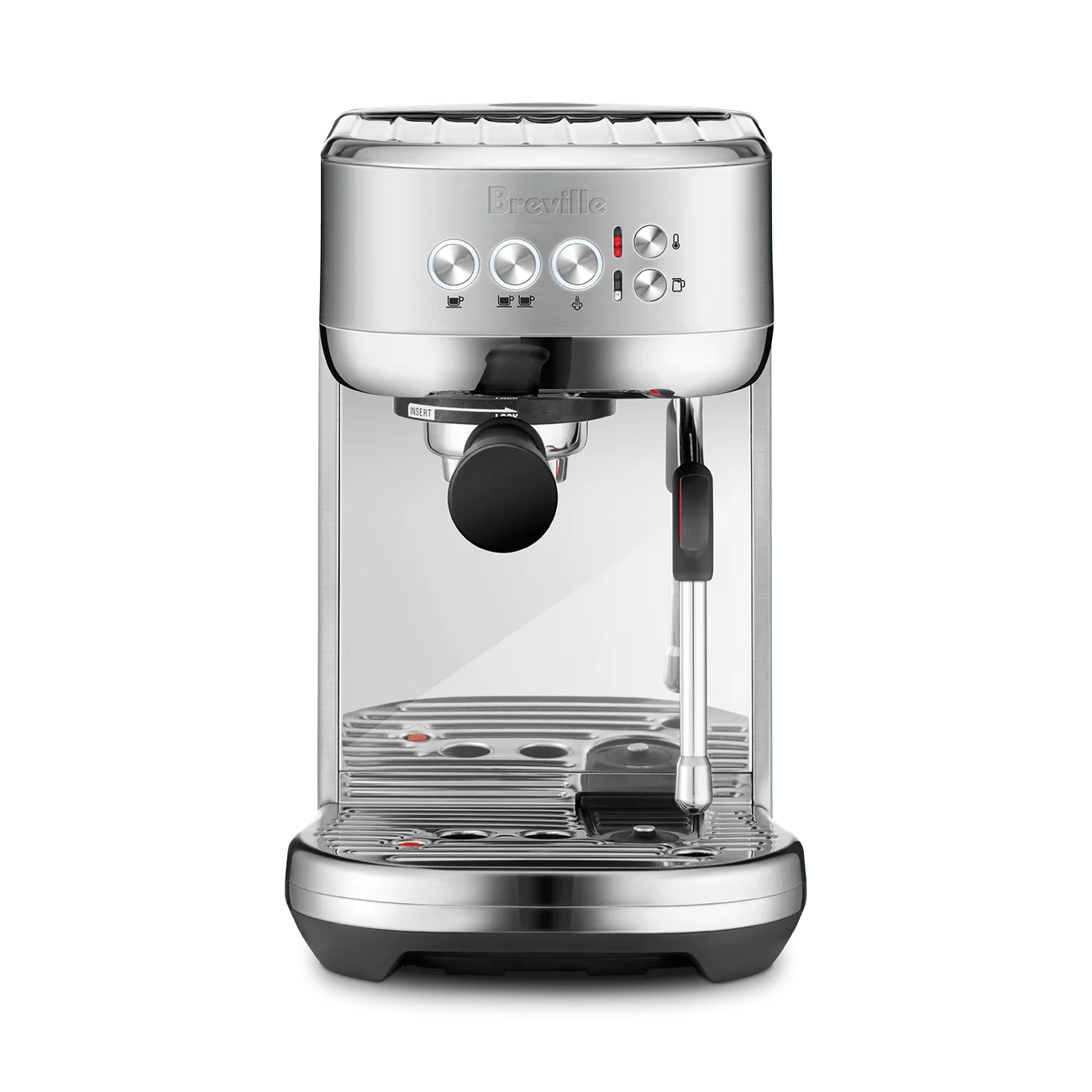
1. Breville Bambino Plus — Best Overall ($400)
The Bambino Plus is the smartest design in home espresso. It’s not the most “serious” machine (plastic body, thermoblock instead of boiler), but it produces better results than anything else at this price by a significant margin.
The good: 3-second warm-up. Not a typo — three seconds from cold to brewing temperature. The PID controller keeps temperature stable within ±2°F across shots, which is remarkable for a thermoblock machine. The automatic steam wand produces microfoam that rivals $800 machines — the auto-setting is actually good enough that I stopped doing manual steaming. Shot volume is programmable via the manual button (hold to pre-infuse, release to full pressure, press to stop).
The bad: The 54mm portafilter instead of the standard 58mm means fewer après-market accessories. The drip tray is tiny (you’ll empty it every 3-4 shots). The water tank is inconvenient to remove for refilling. No three-way solenoid valve means you’ll get some dripping after the shot. And the plastic body won’t last 20 years like a Gaggia Classic.
Price: $400. Check Price → Verdict: This is the one to buy. Pair it with a decent grinder and you’re making better espresso than most cafes.
2. Gaggia Classic Pro — Best for Tinkerers ($450)
The Gaggia Classic Pro is practically unchanged since 1991, which tells you something about both its design quality and its limitations.
The good: Commercial-style 58mm portafilter, brass boiler, three-way solenoid valve, and OPV adjustment. Everything is user-serviceable — you can replace the pump, the boiler, the steam valve, the group head gasket. Parts are cheap and widely available. With two mods (PID controller + 9-bar OPV spring), this machine competes with $1,000+ machines. The steam wand is now a proper single-hole commercial style (they finally fixed the awful panarello in the Pro model).
The bad: Out of the box, it’s mediocre. The OPV is set to 12+ bars from the factory (too high for proper extraction — you need to swap to a 9-bar spring for $5). No temperature control without adding a $100 PID mod. The steam power is weak compared to the Bambino Plus. Heat-up time is 15+ minutes. You’ll need to temperature surf to get consistent shots.
Price: $450. Check Price → Verdict: A project. Buy this if you want to learn espresso machine mechanics and are willing to mod it. Skip if you just want good espresso with minimum effort.
3. De’Longhi Dedica EC685 — Best for Beginners ($280)
The Dedica is a slim, approachable machine that makes decent milk drinks with minimal learning curve.
The good: At 6 inches wide, it fits where nothing else does. The Thermoblock heats up in 40 seconds. The “My Latte” steam wand folds away and produces acceptable (not great) microfoam. The pressurized baskets forgive bad grind and stale beans — you get pseudo-crema even with pre-ground coffee. This is the perfect machine for someone who drinks lattes and doesn’t want to become an espresso hobbyist.
The bad: The 51mm portafilter is non-standard. The steam wand can’t be upgraded to a proper commercial tip without major modification. Internal components are plastic — it’s not built to last 10 years. Temperature stability is the worst in this roundup (±5°F across shots). The drip tray is comically small.
Price: $250-300. Check Price → Verdict: The best “I just want a latte” machine. Not for espresso purists.
4. CASABREWS 5700 — Best Value ($140)
The CASABREWS 5700 is a sleeper. For $140, this machine pulls shots that beat the Philips and De’Longhi super-automatics at 3x the price.
The good: 20-bar Italian pump (actual pressure at the group is around 15 bars — still too high, but workable). The steam wand is a single-hole commercial style that produces surprisingly good microfoam. The 58mm portafilter takes standard accessories. The PID controller keeps temperature more stable than the Dedica. For $140, the shot quality is genuinely impressive.
The bad: Build quality is questionable — the housing rattles, the buttons feel cheap, and the steam control knob is a thin plastic piece that will eventually break. The pressurized baskets are mediocre — you need to buy single-wall baskets (which fit standard 58mm sizes) to get real crema. No three-way solenoid valve. Customer support is Amazon-only.
Price: $140. Check Price → Verdict: Best espresso machine under $200 by a wide margin. But you’re gambling on longevity.
Comparison Table
| Feature | Bambino Plus | Gaggia Classic | Dedica | CASABREWS | Philips 3200 | Calphalon Temp IQ |
|---|---|---|---|---|---|---|
| Price | $400 | $450 | $280 | $140 | $500 | $350 |
| Group size | 54mm | 58mm | 51mm | 58mm | 54mm | 54mm |
| Heating | Thermoblock | Brass boiler | Thermoblock | Thermoblock | Thermoblock | Thermoblock |
| Warm-up | 3 sec | 15 min | 40 sec | 60 sec | 30 sec | 30 sec |
| PID | Yes | No (add $100) | No | Yes | Yes | No |
| Steam type | Auto/manual | Manual | Manual | Manual | Auto | Manual |
| Solenoid valve | No | Yes | No | No | No | No |
| Type | Semi-auto | Semi-auto | Semi-auto | Semi-auto | Super-auto | Semi-auto |
| Weight | 12 lb | 22 lb | 8 lb | 10 lb | 15 lb | 11 lb |
What We Skipped
- Philips 3200 Superautomatic: Convenient — press button, get latte. But at $500, the espresso quality is worse than any semi-automatic here. The grinder is ceramic burr (adequate) and the steam wand is auto (mediocre). You’re paying for convenience, not quality.
- Calphalon Temp IQ: Underwhelming for $350. Temperature stability was poor, steam wand was weak, and the build quality felt cheaper than the $200 De’Longhi.
- Nespresso Vertuo: Not espresso. If you’re okay with capsules, it’s fine. But it doesn’t belong in an espresso discussion.
Bottom Line
Good espresso at home has three requirements: freshly roasted beans (2-4 weeks off-roast), a burr grinder (Baratza Encore ESP or better), and a machine with temperature control. If you skip any of these, your espresso will disappoint.
If you want the best espresso: Breville Bambino Plus ($400) + Baratza Encore ESP ($200). Total $600, and it matches $1,500 setups for milk drinks.
If you want a project: Gaggia Classic Pro ($450) + 9-bar spring mod ($5) + PID kit ($100). Add a grinder ($200) and you’re at $755 for a machine that will last 20 years.
If you just want lattes: De’Longhi Dedica ($280). It’s good enough for milk drinks and takes up no counter space.
Insider Tips Nobody Tells You
Pre-infusion matters more than pressure — All $500 machines claim 15-20 bars. But without pre-infusion (low-pressure wetting before full pressure), the water channels through the puck and you get uneven extraction. Hold the manual button for 5 seconds on the Bambino Plus for a pseudo-pre-infusion.
The grinder matters more than the machine — At this price point, 70% of shot quality comes from the grinder. A $50 blade grinder ruins espresso from any machine. A $200 Baratza Encore ESP with a $100 machine makes better espresso than a $1,000 machine with stale pre-ground coffee.
Descaling frequency depends on your water — Most manufacturers say “every 3 months.” If you have soft water, every 6-9 months is fine. If you have hard water… descale monthly. Scale buildup inside the thermoblock is the #1 killer of sub-$500 espresso machines. Use Third Wave Water or distilled water with mineral packets.
Pressurized baskets hide bad shots — Every machine under $200 comes with pressurized baskets. They force water through a single tiny hole to create fake crema. They also mask stale coffee and bad grind. If you want real espresso, buy single-wall (non-pressurized) baskets — they’re $15 and transform the machine.
FAQ
Do I need a separate grinder for espresso? Yes. Pre-ground coffee goes stale in hours. The ideal espresso shot uses beans roasted 4-14 days ago, ground immediately before brewing. A burr grinder with espresso capability (fine adjustment) is non-negotiable. Budget at least $150 for a grinder.
Espresso machine or Nespresso: which is better? Nespresso is more convenient and consistent — you push a button and get a decent shot. A real espresso machine requires skill, good beans, and maintenance. But real espresso tastes dramatically better. If you value time over taste, get Nespresso. If you value taste over time, get a real machine.
How often should I clean my espresso machine? Backflush with cleaning detergent every 50-100 shots. Rinse the group head after every shot (just run water through it). Descale every 3-6 months depending on water hardness. Clean the steam wand after every use (purge steam for 2 seconds, wipe with a damp cloth).
Can I make espresso without spending $400? A $50 moka pot on the stove makes strong coffee that resembles espresso. A $30 Aeropress with a fine grind makes something closer to espresso. A $250 Flair Neo is a manual lever machine that makes genuine espresso. They all require more effort than a semi-automatic machine.
What’s the difference between a boiler and thermoblock? A boiler (Gaggia Classic) heats a reservoir of water and maintains temperature. It takes 15 minutes to warm up but holds stable temperature during extraction. A thermoblock (Breville Bambino) heats water on demand as it flows through a metal block. It warms up in seconds but can struggle with temperature stability on back-to-back shots. For home use, a good PID-controlled thermoblock (Bambino Plus) performs better than an unmodded brass boiler.
Prices and availability subject to change. We may earn a commission through affiliate links.