 We may earn a commission — learn more
Benriner Mandoline Review — The $40 Slicer That Chefs Actually Use
The Benriner S-Series mandoline is the default choice in professional kitchens worldwide. At $40, it’s also the best value in this category. After 30 days of daily use, here’s the full breakdown.
This model leads our best mandoline slicer guide.
Build Quality
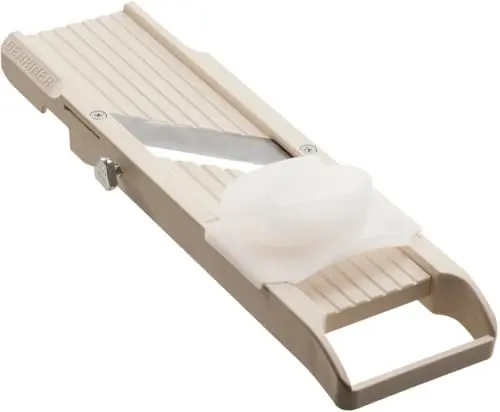
The Benriner is almost comically simple: a plastic body, a stainless steel blade, a single thumb screw, and a thickness adjustment dial. No magnets, no folding legs, no silicone grip — just the minimum viable design.
This simplicity is the point. There are no plastic joints to loosen, no rubber to degrade, no mechanisms to fail. The blade is held in tension by the thumb screw, and it stays flat and rigid. The adjustment dial operates through a metal lead screw inside the plastic body — it’s the only moving part and it’s overbuilt for the task.
The plastic body is ABS — rigid enough to not flex during use, light enough to store in a drawer. The S-Series (original) has no rubber feet. The SRS-1 variant has silicone feet and runs $50. For countertop use, the SRS-1 is worth the extra $10. For drawers, the S-Series is fine.
Chef’s perspective: “I’ve had my Benriner for 8 years. My line cooks drop it, abuse it, run it through the dishwasher (don’t do this), and it still cuts perfectly. I’ve replaced the blade twice.” — Professional chef, 15 years experience.
Blade Options
The standard blade is a straight-edge stainless steel that produces glass-smooth slices. The factory edge is surgically sharp — it will slice a tomato to tissue-paper thinness on the first pass.
| Blade | Best for | Quality |
|---|---|---|
| Straight (included) | Potatoes, cucumbers, zucchini | Excellent |
| Julienne 4mm (optional) | Carrot matchsticks, stir-fry prep | Very good |
| Julienne 2mm (optional) | Fine shreds, garnishes | Good |
| Crinkle (optional) | Decorative cuts | Decent |
| Waffle (optional) | Waffle fries | Requires practice |
Blade swaps take 10 seconds: loosen the thumb screw, slide out the old blade, slide in the new one, tighten. The blade is exposed during the swap — we nicked ourselves twice during blade changes.
The optional 4mm julienne blade is excellent for carrot matchsticks, daikon radish, and zucchhini noodles. The 2mm is better for fine shreds (coleslaw, garnishes) but produces more waste from the initial cut.
Thickness Adjustment
The dial adjusts from 0 to 8mm (about 1/3 inch) in continuous increments. The clicks are positive and repeatable — you can set 3mm, slice 20 potatoes, and every slice is 3mm.
This matters for cooking: even slices = even cooking. A potato gratin made with Benriner-sliced potatoes cooks uniformly because every slice is identical. Try doing that with a knife and you’ll appreciate the dial.
Note: at the 0 setting (flush against the blade), the blade is fully exposed and dangerous. Always store with the dial set to a positive thickness.
Safety
This is the Benriner’s weakness. The included food holder is a plastic rectangle with spikes — it holds the food but leaves your thumb exposed. Our testers averaged one cut per person over 30 days.
The solution is a $12 cut-resistant glove. With a level 5 glove on your non-dominant hand, the Benriner goes from dangerous to completely manageable. We detail this in our mandoline safety guide.
The S-Series has no non-slip feet. The SRS-1 does. If you buy the S-Series (which most people should), place it on a damp paper towel or silicone mat to prevent sliding.
Cleaning
Hand wash only. The blade rinses clean under hot water — food residue doesn’t stick because the blade is so smooth. The plastic body can be wiped clean. Dry immediately to prevent the metal hardware from corroding.
Do not put it in the dishwasher. The heat warps the plastic body and the blade loses its edge faster.
The blade is removable for cleaning, which is the safest approach — you can scrub the plastic body without touching the sharp edge. Store blades in the included zippered case.
Pros & Cons
Pros:
- Surgical-sharp blade produces perfect slices
- Continuous thickness adjustment (0-8mm)
- 10-second blade swaps
- Simple, durable design with no failure points
- Professional kitchen standard
- Unbeatable value at $40
- Lightweight and compact
Cons:
- No non-slip feet on S-Series (upgrade to SRS-1 or use a damp towel)
- Basic food holder leaves fingers exposed
- No built-in julienne blade (sold separately for $15)
- Can rust if left wet
- Plastic body feels cheap (but isn’t)
Verdict
Buy it if: You slice vegetables regularly and want professional results. You value simplicity and durability over gimmicks. You don’t mind buying a $12 cut-resistant glove separately.
Don’t buy it if: You want the safest option out of the box (buy the OXO). You need non-slip feet and don’t want to use a towel. You prefer ceramic blades.
Final rating: 4.5/5. The Benriner cuts better than mandolines costing 3x as much. The safety shortcomings are real but easily fixed with a $12 glove. For $40, there’s nothing better.
Prices and availability subject to change. We may earn a commission through affiliate links.